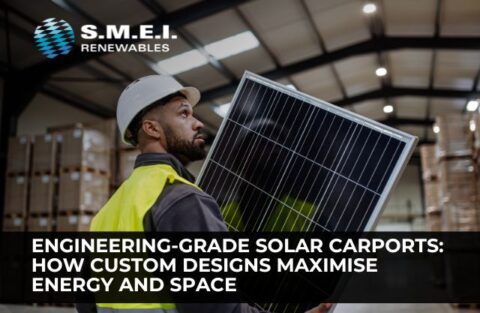
Solar carports offer more than shade or parking cover – when engineered correctly, they become high-performance dual-purpose structures that optimise solar yield, maximise parking area usability, endure harsh weather, and add significant property value. While prefabricated or off-the-shelf kits may look cheaper initially, custom-engineered solar carports unlock gains in energy, safety, longevity, and space utilisation.
What Does “Engineering-Grade” Mean
When we say engineered solar carports, we refer to structures custom designed for a specific site or purpose, with full structural, civil, mechanical, electrical, and aesthetic integration. Key features include:
- Full structural steel design for load combinations: self-weight, panel weight, dynamic loads (wind, seismic/hail), snow (if applicable), and live loads (vehicle clearance, foot traffic, rain load etc.).
- Foundations and anchors designed for the specific soil and geotechnical conditions of the site.
- Steel material selection for strength, corrosion resistance (galvanisation, coatings, etc.), welding quality, fatigue resistance.
- Integration of solar panel layout, cable routing, inverter placement, drainage, lighting, EV charging or other add on services as may be required.
- Architectural finishing, aesthetics, alignment with property or site design, pedestrian and/or vehicle access, shade, safety.
Prefab Kits vs Custom-Engineered Solutions: Comparative Trade-Offs
| Feature | Prefab/Kit Carports | Custom/Engineered Carports |
| Cost (CAPEX) | Lower initial purchase cost; standardised forms; minimal design time. But may require adaptation onsite. | Higher upfront cost due to engineering, site‐specific foundations, civil works, customisation. |
| Structural Adequacy & Safety | Basic designs that may not account fully for local wind loads, soil conditions, unusual site geometry. Risk of over-engineering or under-engineering. | Precisely designed to local standards (wind, seismic, soil), ensuring safety and compliance and reducing risk of damage, insurance claims, or failure. |
| Solar Yield & Panel Performance | Layout may not be optimised: shading issues, sub-optimal tilt or orientation, limited panel count because of prefabricated sizing. | Optimised layout for sun path, panel spacing, tilt/azimuth, minimal shading; better cooling and airflow, leading to improved yield. |
| Space Utilisation & Parking Efficiency | Kits may force parking rows, vehicle clearance, circulation that are suboptimal; may waste height or interfere with traffic flow. | Custom design adapts to site constraints: circulation, vehicle clearance, efficient column spacing, cantilever designs, height adjustments for large vehicles. |
| Durability & Maintenance | Prefab kits may use lower grade steel, minimal corrosion protection, generic foundations; maintenance may be harder. | Engineered steel grades (galvanised, coated), better welding, tailored durability, easier access to components, better maintenance planning. Any adjustments, additions, or repairs can be easily attained and carried out. |
| Aesthetics & Integration | Generic look; limited adaptability to architectural style; possible mismatch with property / urban fabric. | More flexibility in finishes, integration of architectural features, branding, visual appeal, matching site lines. |
| Lead Time & Risk | Faster procurement and smaller design time; but higher risk of modification on site, delays due to site mismatch. | Longer design phase; but less “surprises” on site; better risk management, more predictable outcomes over lifetime. |
| Long-term ROI & Value | Lower initial barrier; but yield losses, maintenance, shorter lifespan may degrade ROI. | Better energy yield, longer lifetime, fewer failures, better property value; often higher IRR over project horizon. |
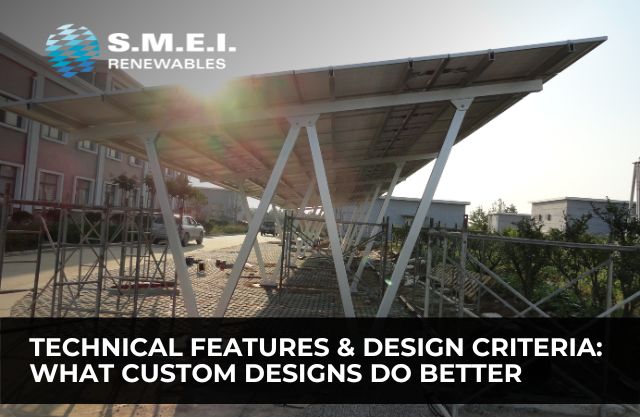
Technical Features & Design Criteria: What Custom Designs Do Better
Here are some of the structural and/or engineering design features that custom, engineered solutions typically incorporate – features that prefab kits often omit or simplify:
1. Steel Material Specification & Corrosion Resistance
- Use of hot-dip galvanised steel or coated/pigmented protection to resist corrosion especially in coastal, industrial, or high-rainfall areas.
- Selecting steel sections (I-beams, hollow sections, purlins) sized for local loads and fatigue.
- Weld quality done to ISO3834, bolt specification (grade, coating), use of stainless or corrosion-resistant fasteners.
2. Foundations / Anchorage
- Site‐specific geotechnical surveys to determine soil bearing capacity, presence of soft zones, groundwater level.
- Choosing proper foundation type: drilled piles, strip footings, spread footings, or anchors. If using cantilever or single-post designs, foundations must counterbalance overturning moments.
- Ensuring anchor bolt design, embedment, and concreting meeting structural code standards.
3. Structural Design for Wind, Snow / Hail, Dynamic Loads
- Wind load design per local code (South African National Standards, or equivalent), considering gusts, storm events, uplift, vibration.
- If hail or snow loads apply (less typical in many South African sites but in some local high-altitude zones, hail load matters). Panel impact protection may be necessary.
- Considering dynamic loading: vibrations, thermal expansions, module weight, etc.
4. Layout & Architecture
- Optimising layout for panel orientation & tilt to match site latitude, sun paths, avoid shading from adjacent structures, trees, or internal components (columns, conduits).
- Considering height clearance: to accommodate delivery trucks, vans, or high vehicles if in logistics/commercial property.
- Circulation lanes, vehicle ingress/egress, pedestrian access, safety, walkways for maintenance.
5. Integration of Additional Features
- Conduits for wiring neatly integrated, accessible junction boxes, inverter locations, cable trays.
- Optional features: rainwater gutters, drainage, lighting under carport, EV charging, signage, safety lighting.
- Aesthetics: clean finishes, colour matching, alignments to urban/architectural design scheme.
6. Maintenance Access & Modularity
- Designing for maintenance: safe access to panels, cleaning, replacing components, module removal.
- Modularity allows for extension or modification (e.g. adding more panels or EV chargers) without needing major redesign.
7. Compliance & Certification
- Meeting South African structural design standards, local building codes, electrical safety standards.
- Ensuring drawings & QA procedures, steel fabrication quality, material testing, welding inspection, all done in accordance with ISO 3834 and ISO 9001.
- Insurance and compliance with municipality approvals.
Case Example: Custom Engineered Carport Structures in South Africa / Similar Climates
Schletter SunRide System (South Africa/International): A design based on high-strength hot-dip galvanised steel, with single central supports and cantilevered panels up to 5 m span. The system allows multiple vehicle parking orientations (parallel / herringbone) so parking density is maximised. Foundations are flexible: drilled concrete piles or concrete anchors to minimise excavation impact.
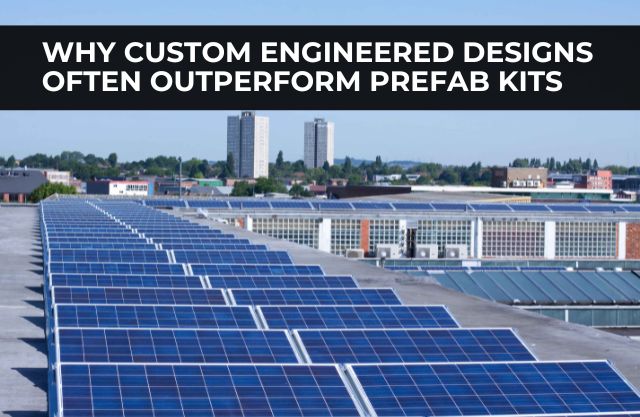
Why Custom Engineered Designs Often Outperform Prefab Kits: Quantified Impacts
Here are specific ways custom designs deliver measurable improvements:
| Metric | Potential Improvement with Engineered Design |
| Solar energy yield | Reduced shading, optimal tilt/azimuth, panel elevation improve yield by a few percent up to 5-10% compared to generic kit layout. Elevated panels are cooler; improved airflow → better efficiency. |
| Parking efficiency / capacity | Better span design, cantilevers or single post supports reduce number of columns or obstructions → more usable parking spaces, easier traffic flow. For example, the cantilever design allows more vehicles parked per area than standard double-row fixed supports. |
| Structural longevity / lifecycle | Proper corrosion protection and steel specification reduce risk of rust / fatigue; better foundations reduce settlement / misalignment. Lifespan maintained; warranty / maintenance costs reduced. |
| Cost of maintenance / downtime | Engineered design reduces unexpected repairs; easier access for component replacement and cleaning; less risk of structural failure or safety compliance failure. |
Pitfalls & Things to Watch (And How to Avoid Them)
Even with engineered designs, mistakes are common. Here are pitfalls and how S.M.E.I. Renewables addresses them before we start building a solution.
| Pitfall | Consequence | Mitigation / Best Practice |
| Under-estimating wind loads or uplift | Frame damage, panel damage, safety risk, insurance liability. | Use local wind speed data; include safety factors; design for the worst credible wind. |
| Poor foundation / soil mismatch | Settling, misalignment, uneven span, structural stress. | Conduct geotechnical study if required; adapt foundation type; use deep piles if needed; proper anchor design. |
| Corrosion (steel / fasteners) | Reduced life; safety risk; higher maintenance; aesthetic degradation. | Specify good coatings / galvanising; use suitable fasteners. |
| Layout/ shading mistakes | Reduced energy output; mismatch in row spacing; wasted premium on more panels. | Sun path + shading analysis; layout design early; use custom shapes and layouts if site is irregular. |
| Insufficient height or clearance | Hitting vehicles; poor user experience; constraints on traffic flow or future uses (e.g. high vehicle access, EV charging). | Define vehicle fleet heights; future-proof for larger vehicles; plan circulation paths. |
| Poor cable management / safety / code non-compliance | Fire risk, safety hazards, unsightly installations, regulatory penalties. | Full electrical design; easy access for inspection; conduit trays; proper grounding; follow SA building and electrical codes. |
How S.M.E.I. Renewables’ Experience Makes the Difference
Here’s how S.M.E.I. brings engineering, fabrication, and construction excellence to custom solar carports:
- Steel fabrication capability: In-house or trusted partner fabrication of steel frames, able to produce hot-dip galvanised / corrosion-protected steel, high quality welds.
- Structural & site engineering: Geotechnical studies, wind load analysis, structural design tuned to site, foundation design adaptively chosen, structural drawings that comply with certification and local building codes.
- Design integration: We design for panel layout, tilt, orientation, cable routing, inverter siting, EV-charging integration, lighting, drainage etc., working with architects to match aesthetics.
- Construction management & Quality Assurance: Project schedule optimisation, material quality checks, welding QC, installation alignment, safety, inspections, commissioning, all done in accordance with our ISO 3834, 9001, and 45001 certified standards.
- Maintenance planning & lifecycle cost modelling: Estimating not just upfront cost, but expected maintenance, component replacement, yield losses due to aging, ensuring that ROI / lifecycle cost is clearly understood.
Practical Decision-Framework for Architects / Developers
When you’re deciding between a simple prefab kit and a custom engineered solar carport, you can run through something like this decision-framework:
- Define site constraints: parking lot shape, usable area, height clearance, soil type, climate, exposure to wind, corrosive environment (salt spray, industrial atmospheres), vehicles types.
- Define energy goal & yield requirements: how much energy do you need the carport to offset (percentage of daytime load, PPA obligations, EV charging)? What tilt/orientation maximise that?
- Define design / aesthetic goals: How important is appearance? Integration with architectural style, signage, colouring, branding, lighting etc.
- Estimate CAPEX vs Lifecycle Value: Cost of structure + solar system + foundations + installation vs yield over 20-25 years, maintenance costs, downtime, insurance, resilience.
- Risk assessment: weather, structural failure, corrosion, shading, damage, maintenance accessibility.
- Supplier & fabrication capability check: Does your vendor have experience with structural steel, custom design, QA/QC, in-house steel fabrication or trusted partners, ability to warranty, supply chain local / imported.
Conclusion
Custom-engineered solar carports consistently outperform prefab kits in every area that matters – energy yield, safety, durability, space utilisation, aesthetics, and long-term value. For commercial developments such as retail centres, logistics hubs, campuses, or mixed-use properties, a well-designed carport does far more than provide shade: it generates measurable energy savings, enhances property value, and improves the user experience with features like integrated EV charging.
With proven expertise in steel fabrication, structural engineering, and full construction management, S.M.E.I. Renewables ensures that solar carports are not just shelters, but high-performance assets built to last.