Solar Carports for Mining and Heavy Industry: Engineering for the Environments That Test Everything

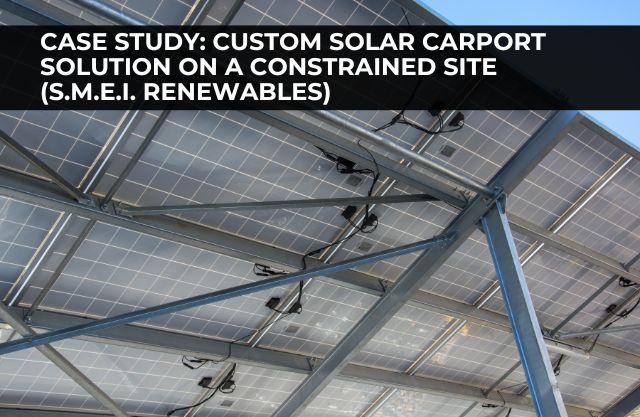
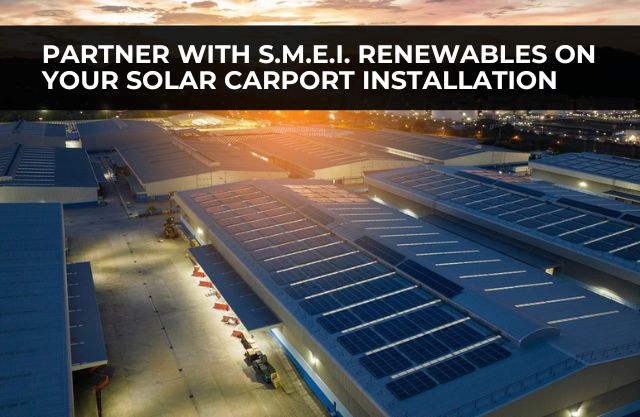
Solar carport structure providing covered parking at an industrial mining site

Mining operations do not give infrastructure an easy ride. The dust is abrasive. The vehicles are large. The shift patterns are punishing. Power demand is high, often concentrated in daylight hours, and the consequence of an unplanned outage can ripple through an entire production cycle.

Against that backdrop, solar carports might not seem like the obvious starting point for a renewables conversation. They are more commonly associated with retail parks and corporate campuses than haul roads and workshop yards. That perception understates what a well-engineered solar carport can actually do on a mining or heavy industrial site and it ignores the structural and electrical capabilities that make the difference between an installation that survives the environment and one that does not.

S.M.E.I. Renewables builds solar carports within a parent company whose 25+ year track record is in structural, mechanical, and electrical construction on exactly these kinds of sites. This article is a practical look at where solar carports fit in mining and heavy industry, what the engineering requirements actually are in those environments, and what decision-makers should be asking before the design begins.

Where Solar Carports Fit on Mining and Industrial Sites

The most common objection to solar carports in heavy industrial settings is spatial: mining operations are space-constrained around their operational core, and the assumption is that there is nowhere to put a covered PV structure without displacing something more important.

In practice, the opposite is often true. Mining operations generate substantial covered parking demand across multiple categories light vehicles for personnel, service vehicles for maintenance crews, equipment bays for smaller mobile plant, and logistics staging areas. These are spaces that already exist, that already require some form of weather or sun protection in South Africa’s climate, and that sit under open sky for the majority of their useful life. A solar carport does not compete with those functions. It adds a productive layer above them.

The energy alignment is unusually strong. Mining operations typically run their highest electrical loads during daylight hours processing equipment, ventilation, pumping, and materials handling are all daytime functions. Solar generation peaks at exactly the same time. This is the set of conditions where solar generation can reduce Scope 2 emissions where it displaces purchased grid electricity, and may also reduce Scope 1 emissions where it reduces reliance on on-site diesel generation.

For operations that already run diesel generation or hybrid power systems, this alignment has a direct financial consequence. Every kilowatt-hour generated by a rooftop or carport solar system during peak production hours is a kilowatt-hour that does not have to be generated at diesel cost. At typical commercial diesel rates in South Africa and at the distances from the grid that characterise many mining operations the cost differential is significant.
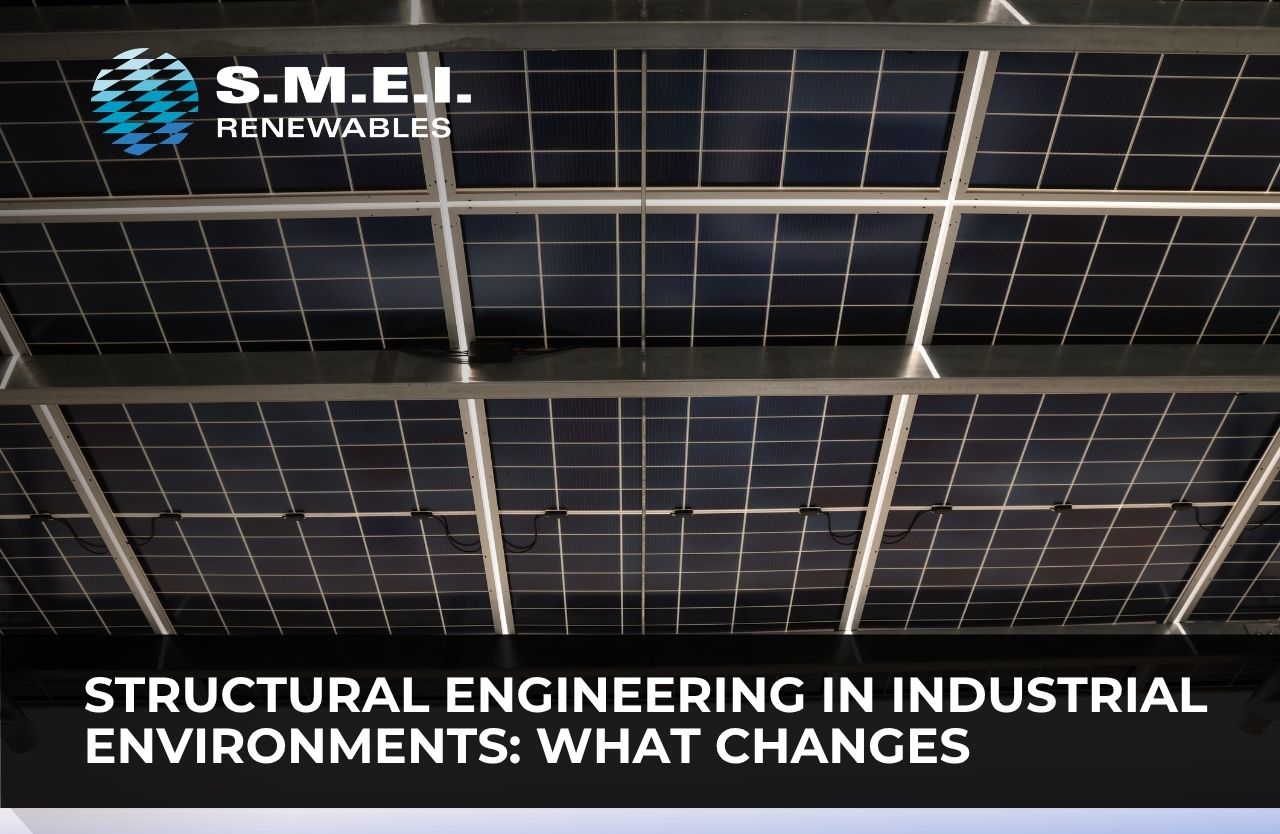
Galvanised steel solar carport framework engineered for heavy industrial environments

Structural Engineering in Industrial Environments: What Changes

A solar carport designed for a corporate headquarters car park and a solar carport designed for a mining workshop yard are not the same structure. The engineering inputs are different, the design loads are more demanding, and the durability requirements carry higher stakes.

Wind and dust loading. Mining sites in South Africa’s Northern Cape, North West, and Limpopo provinces sit in regions with both high dust burden and significant wind exposure. Dust accumulation affects module performance, a well-documented relationship in semi-arid and arid environments, but it also adds dead load to the structure in a way that standard carport design tables do not account for. Wind loading must comply with SANS 10160-3:2019, and in regions where convective gust fronts are a regular seasonal feature, site-specific wind analysis is the appropriate starting point rather than generic zonal load tables.

Clearance requirements. Standard commercial carport clearance calculations are based on the passenger vehicle design envelope. Mining and industrial sites operate a completely different vehicle fleet. Light duty bakkies and service vehicles need a minimum clearance of approximately 2.8 to 3 metres. Larger maintenance vehicles, elevated flatbeds, and mobile workshop units routinely need 4.5 metres or more. Getting this wrong does not produce a minor inconvenience. It produces a structure that blocks operational access and must either be modified or removed. Clearance decisions must be made from actual vehicle survey data, not assumptions.

Corrosive and abrasive environments. Mineral extraction sites generate airborne particulates that are more chemically aggressive than typical atmospheric dust. Sulphide ore processing, for instance, generates sulphurous compounds that can accelerate zinc depletion in standard hot-dip galvanised coatings. This does not mean galvanised steel is the wrong material choice, it usually remains the correct one, but it does mean that coating specification must account for the site’s specific corrosion category rather than a generic ‘industrial’ classification. SANS 121 sets minimum coating thicknesses by base steel dimensions; the question of which coating category applies to a specific mining environment requires site-specific assessment.

Seismic and vibration considerations. Heavy plant, haul road proximity, and blasting activity on operating mines create vibration inputs that do not appear in standard carport design assumptions. Column bases, connection details, and foundation embedment depths on sites with regular ground vibration inputs require analysis that accounts for these loading cycles explicitly.
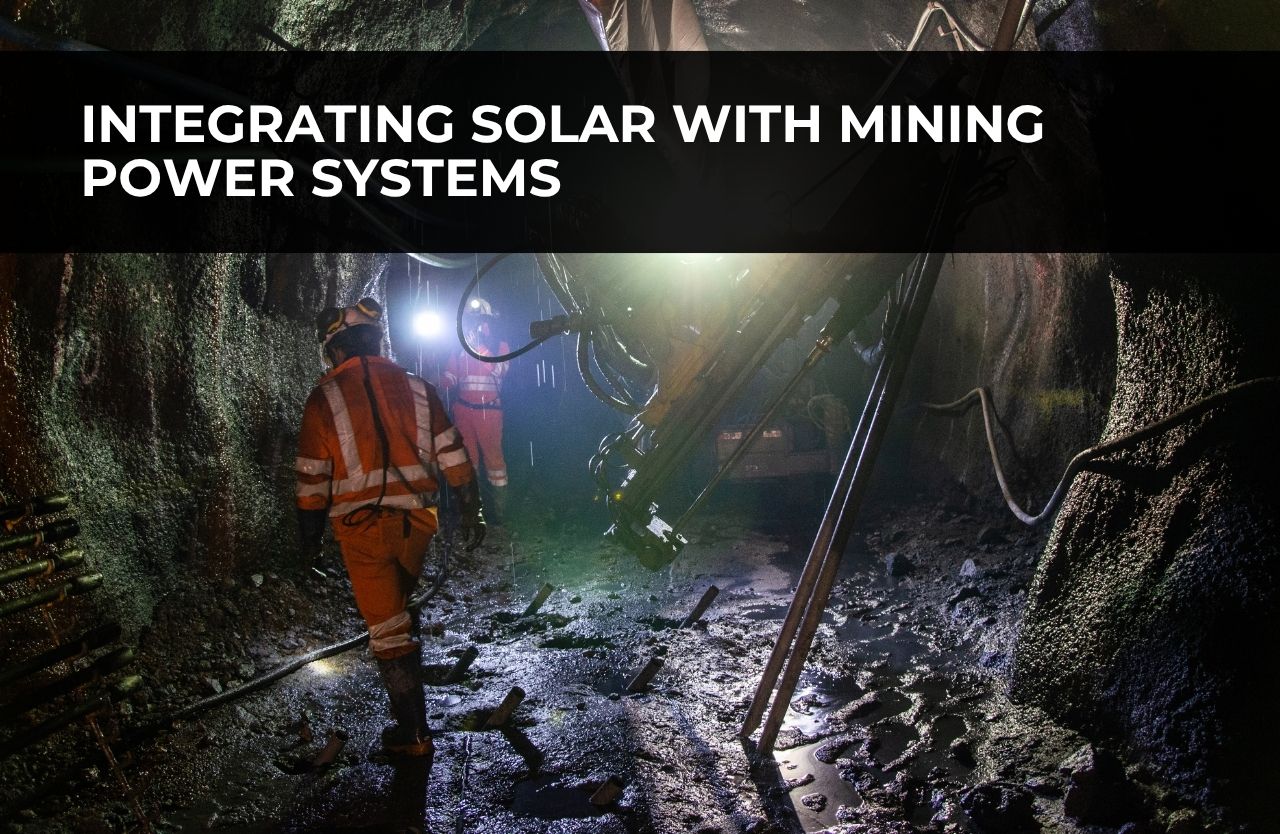
Underground mining operation with workers and drilling equipment integrating Solar with Mining Power Systems

Integrating Solar with Mining Power Systems

A solar carport on a mining site is not a standalone power source. It is a generation asset that needs to be integrated into an existing power system, one that, for most South African mining operations, includes a combination of Eskom grid supply, diesel generation, and increasingly, battery storage.

The integration design determines whether the solar carport delivers its expected financial return. Key decisions include:

  • Where the inverters connect into the existing LV or MV distribution board, and whether that connection point has available capacity.
  • How the system handles grid outage conditions whether it is islanding-capable for critical load support, or whether it shuts down safely to avoid backfeed.
  • Whether the generation profile is being actively monitored and dispatched against the site’s tariff structure, or simply generating whenever the sun shines.
  • Whether battery storage integration is required to shift morning and evening peaks, or whether the daytime demand alignment makes storage unnecessary for the initial phase.


For mining operations with embedded network licences or private power purchase agreements, the metering and compliance requirements add another layer to the integration design. These are not insurmountable, but they need to be addressed during the engineering phase, not discovered during commissioning.

S.M.E.I. Renewables carries full EC&I (Electrical, Control and Instrumentation) capability inside its delivery model. That means the generation integration, the protection relay settings, the SCADA interface, microgrid control, and the monitoring system are all engineered and installed by the same team that designs and builds the structure. On a mining site, where system integration failures carry operational consequences, that matters.

Operational Advantages Beyond the Energy Bill

The financial case for solar carports on mining sites is usually led by energy cost reduction, and the numbers are generally compelling. But the business case is broader than the electricity tariff calculation.

ESG reporting and compliance: Mining companies operating under modern environmental and social governance frameworks face increasing scrutiny on Scope 1 and Scope 2 emissions. Solar generation that directly displaces diesel or coal-fired grid electricity reduces Scope 2 emissions in a way that is measurable, verifiable, and reportable. For companies subject to investor ESG requirements or government licensing conditions with renewable energy components, this is not a secondary consideration. It is a compliance obligation with financial consequences if not met.

Energy resilience: Eskom’s load shedding record over the past decade is well understood by every energy manager in South African mining. Solar carport generation does not eliminate grid dependency most systems without battery storage will still go offline during a grid outage, but hybrid configurations with battery backup can maintain critical loads through scheduled outages and reduce the operational impact on production-critical systems.

Covered infrastructure with dual function: A solar carport covers vehicles and equipment that would otherwise be exposed to hail, intense UV, and temperature extremes. On mining sites where vehicle fleets represent substantial capital assets, that protection has a measurable value that belongs in the business case alongside the energy yield calculation.

Personnel and contractor amenity:z Mining operations in remote locations depend on their ability to attract and retain skilled personnel. Covered, shaded parking and charging points for EVs or hybrid vehicles are amenity factors that have become increasingly relevant in recruitment and retention conversations, particularly for technical and engineering staff.

The Right Partner for the Right Environment

Solar carports in mining and heavy industry are not a simplified version of a retail installation. They are a more demanding version of it, with higher structural requirements, more complex power integration, more aggressive operating environments, and higher operational consequences if they underperform or fail.

Getting them right requires a team that understands both the solar system and the industrial environment it is going into. That combination is not common. It is what S.M.E.I. Renewables was built to provide.

If you are evaluating solar carport options for a mining or heavy industrial facility, contact S.M.E.I. Renewables to discuss a site-specific assessment. We operate under ISO 9001, ISO 45001, and ISO 3834 certified quality systems and carry full structural, renewable, and EC&I capability in-house.
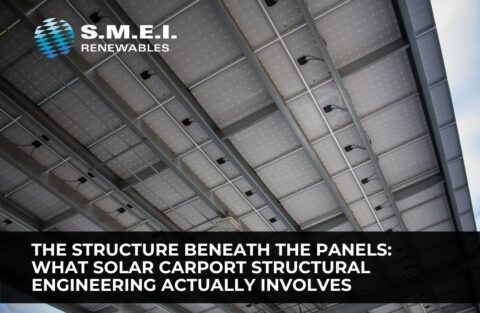
The Structure Beneath the Panels: What Solar Carport Structural Engineering Actually Involves

Spend enough time in the commercial solar sector and you will hear the same mistake repeated in different ways. A procurement manager asks for a solar carport quote, receives a price per watt, and assumes the structure is a commodity. A developer selects a supplier based on module efficiency and overlooks the steel specification entirely. A property owner signs off on a layout without anyone having looked at the ground beneath the parking lot.

These are not hypothetical scenarios. They are patterns that show up on project after project, and they share a common root: the assumption that the structure holding a solar carport together is a secondary consideration.

It is not. At commercial and industrial scale, a solar carport is a purpose-built steel structure that must carry significant permanent loads, resist wind forces that act on it from multiple directions simultaneously, anchor into ground conditions that can vary dramatically within a single site, and house a complex electrical system without any of those requirements compromising any of the others. Then comes the space and height restraints that need to be suited to the installation area, that standard modular carport products do not always suit. Getting that right takes integrated engineering. Getting it wrong is expensive, and sometimes dangerous.

At S.M.E.I. Renewables, structural and electrical design sit inside the same delivery model. This article explains why that matters, and what the solar carport structural engineering actually involves.

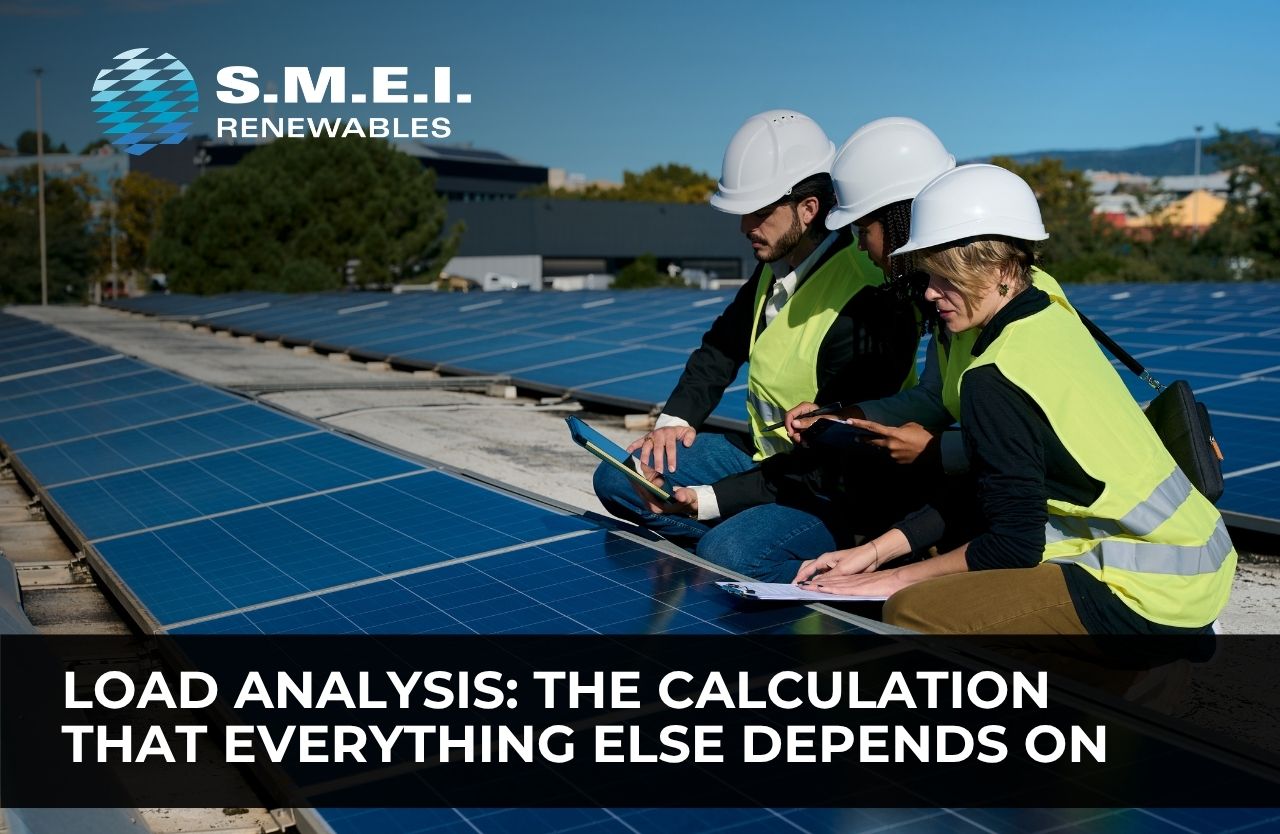
Load Analysis: The Calculation That Everything Else Depends On

Before a single structural member is sized, an engineer must account for every force the carport will experience across its design life. There are three categories that govern this.

Dead loads are the permanent, downward forces on the structure: the steel frame, the PV modules, the mounting rails, the conduit runs, the gutters. For a commercial carport carrying a full array of modern bifacial modules with racking and wiring infrastructure, the dead load contribution from the panel system alone runs between 15 and 25 kilograms per square metre. On a structure covering 80 parking bays, that represents a panel and racking dead load of roughly 30 to 50 tonnes before the weight of the steel frame itself is counted. Every weld, every bolted connection, and every foundation anchor must be designed to carry that weight continuously for 25 years.

Wind loads are where the engineering becomes genuinely complex, and where the South African context makes generic design thinking inadequate. The national wind loading code, SANS 10160-3, was significantly updated in 2019 following years of research into the country’s distinctive wind climate. The partial safety factor for wind loading was raised from 1.3 to 1.6, a substantial change that reflects what researchers at Stellenbosch University had been documenting for years: South Africa’s wind environment does not behave the way European standards assume. The interior experiences convective thunderstorm gust fronts during summer. The western and southern coast is dominated by extratropical cyclones. These are different mechanisms with different pressure characteristics, and both must be correctly accounted for in solar carport design engineering.

The geometry of an open canopy structure amplifies this complexity. Unlike a walled building, where wind pressure acts primarily on the facade, a solar carport canopy is exposed on its upper and lower surfaces simultaneously. Wind flowing over the canopy generates suction on the upper surface through flow separation, while simultaneously pressurising the underside, producing net uplift forces that must be fully resolved through the columns and into the foundations. Research by CPP Wind Engineering has documented structural failures in code-compliant solar mounting systems at wind speeds below design thresholds, specifically in cases where the drive to reduce steel content pushed the safety margin too thin. For carport structures, the lesson is consistent: designing to the minimum the code permits is not the same as designing for the environment the structure will actually experience.

Dynamic and fatigue loads complete the picture. Thermal expansion and contraction of steel across South Africa’s temperature range, wind-induced vibration in cantilevered spans, and the cumulative fatigue effects of tens of thousands of loading cycles over a 25-year design life create stresses that do not show up in a static load calculation. Connection failures in carport structures are rarely dramatic. They develop slowly, through micro-cracks at weld toes, through bolt holes that elongate over time, through column bases that work loose under repeated uplift. Designing against these outcomes requires engineers who understand how structures behave dynamically, not just how they sit under a single design load.

Foundation Design: Why the Ground Beneath the Parking Lot Cannot Be Assumed

South Africa’s geology is varied enough to make any assumption about ground conditions a liability. The country has widespread expansive clays that heave and shrink with moisture variation, and dolomitic ground that requires specialist stability assessment before any structural work can be approved. Corrosive acidic soils attack below-ground steel, and in many parts of the country near-surface rock or calcrete dictates foundation type as much as bearing capacity does.

A geotechnical study commissioned for a proposed solar PV facility at Kakamas in the Northern Cape found soil consistency ranging from very loose to very stiff across the same site boundary. Cone penetration tests revealed variability that would have required entirely different foundation approaches in different parts of the same project. The study concluded that driven piles and earth screws were the appropriate solution, a conclusion that could only have been reached through investigation. A separate geotechnical investigation for a 200-hectare solar plant near Lime Acres in the Northern Cape found cemented calcrete at depths between 0.1 and 0.5 metres, a condition that immediately rules out driven piles and demands a bespoke foundation approach.

The consequences of skipping or under-scoping a geotechnical survey are well documented in the broader South African construction context. A peer-reviewed review of problem soils in South Africa records case after case where unidentified expansive soils and dolomitic conditions imposed remediation costs that dwarfed the original site investigation budget. For a solar carport, the stakes are compounded: a foundation failure does not just damage the structure, it compromises the PV array, the electrical infrastructure, and the business case for the project.

Soil corrosivity is a related concern that is frequently overlooked in commercial solar carport projects. According to technical guidance published by Solar Power World, soil chemistry must be assessed to determine whether below-ground steel requires corrosion protection beyond standard galvanisation. In aggressive soils, standard zinc coating thicknesses are insufficient over a 25-year design life. This is not a theoretical risk in South Africa, where industrial sites, former agricultural land, and areas with high-sulphur geology are common locations for commercial solar development.

The outcome of the geotechnical investigation determines the pile type, the embedment depth, the concrete specification, and the overturning resistance required at each column base. None of these can be reliably specified without that investigation in hand.

Steel Specification and Corrosion Protection: What Compliance Actually Means in Practice

There is a version of this conversation that stays at the level of “hot-dip galvanised steel is required.” That is true, but it is not sufficient. The question is which specification, to what thickness, verified by whom, with what documentation trail, and for which corrosion environment.

In South Africa, the governing standard for hot-dip galvanised coatings on fabricated structural steel is SANS 121:2011, which is technically aligned with the international ISO 1461 standard. SANS 121 specifies minimum zinc coating thicknesses relative to the base steel thickness, with independent verification using electronic thickness gauging at accredited plants. The important word is accredited. Not every galvanising facility in South Africa operates to the same standard, and specifying SANS 121 compliance without requiring an accredited plant carries genuine quality risk.

South Africa’s galvanising capacity has grown significantly in response to solar demand. Transvaal Galvanisers, which operates what it describes as the largest solar substructure galvanising facility in Africa, is capable of processing over 3 tonnes of steel per dip with precision zinc thickness control. Galvatech’s Western Cape facility, expanded in 2024, can now handle structural members up to 13 metres in length specifically to meet the requirements of solar mounting and support structures, while maintaining SANS 121 certification. This matters for commercial projects where long-span beam sections cannot be cut and spliced without compromising structural performance.

Steel section selection for solar carport columns is driven by structural analysis, not by what a supplier has in stock. PVRack’s commercial carport engineering reference documents that hollow structural section columns in commercial carport applications typically range from 150×150 mm to 250×250 mm in cross-section, with wall thickness determined by the governing load case, usually the combination of wind uplift and canopy dead load rather than gravity alone. Weld quality must comply with ISO 3834, and the bolt specification at every connection must account for coating compatibility, installation torque, and long-term joint behaviour under dynamic loading. None of these decisions is standard. They are site-specific, and they all have consequences for how long the structure performs without intervention.

Getting the steel right is a necessary condition for a durable solar carport. But a structure that is metallurgically sound and mechanically overengineered can still fail the project if it was never designed to work within an operating parking facility.

Parking Infrastructure: The Operational Constraints That Structural Engineers Cannot Ignore

A solar carport that performs structurally but disrupts parking operations, blocks emergency access, or fails a municipal building inspection has not succeeded. The structural design must accommodate the site as it exists and as it will be used, not as an engineer might wish it to be.

South African parking standards, established through Department of Transport guidelines that remain the foundational reference for parking bay dimensional requirements in this country, define the standard design vehicle as 4.8 metres in length and 1.8 metres wide, with 90-degree parking configurations requiring a standard module width of 17.6 metres including aisles. Column placement in a commercial solar carport structure must be resolved within these dimensional constraints. Every column that intrudes into a parking bay or narrows an aisle below the minimum width is a problem that costs money to fix after the steel is up. Getting the layout right requires the structural engineer and the civil or site planner to work from the same drawing set, from the beginning.

Clearance height requirements vary significantly by site. Facilities that handle delivery vehicles, logistics trucks, or plant machinery need a minimum canopy clearance of approximately 4.3 metres, as referenced in Steel Pro Group’s technical guidance on carport height design. Standard passenger vehicle facilities can work with lower clearances, but this has direct implications for panel tilt angle and therefore energy yield, which must be accounted for in the energy model. Height decisions are not architectural preferences. They are engineering decisions with financial consequences.

Fire safety compliance is non-negotiable under South Africa’s National Building Regulations and Building Standards Act (Act 103 of 1977). Commercial parking structures for more than 10 vehicles are classified as J4 occupancy under SANS 10400-T, with specific requirements for fire separation, protection systems, and emergency vehicle access. A solar carport structure that covers an entire parking facility and has not been designed around emergency access corridors will not receive municipal approval. This is a constraint that needs to be resolved at the layout stage, not discovered during the approval process.

Electrical Integration: The Decision That Has to Be Made Before the Steel Goes Up

The most avoidable cost on a solar carport project is the cost of retrofitting electrical infrastructure into a structure that was not designed to accommodate it. Cable management, inverter placement, and EV charging conduit all carry structural implications. Address them after fabrication and you are cutting holes, welding brackets, and running surface-mounted conduit through a commercial parking environment. Address them before fabrication and they disappear into the structure cleanly. Of all the electrical decisions that affect the steel design, inverter placement tends to generate the most downstream consequences.

Pure Power Engineering’s widely referenced design guidance recommends centralised ground-level inverter placement over column-mounted distributed configurations for the majority of commercial carport projects. The reasoning is practical: ground-level placement allows equipment to be housed in a secured, weather-protected enclosure, reduces the length of communication wiring between inverters, and means that routine maintenance does not require elevated access equipment. Column-mounted inverters are common in photographs because they look tidy in a sales presentation. In reality, they create O&M complexity that accumulates across the life of the asset.

For EV charging integration, PVRack’s engineering guidance is clear that Level 2 AC chargers at 7 kW per connector can be fed through conduit routed within the carport structural frame, while DC fast chargers at 50 to 150 kW per unit require dedicated conduit sizing and a centralised electrical room. These are not add-ons that can be bolted on later. The conduit pathways, the structural penetrations, and the load-bearing connections for charger mounting hardware all need to be part of the original fabrication drawings. An industrial solar carport designed without this infrastructure in place will cost significantly more to retrofit than it would have cost to include at the outset.

There is also a system-level safety argument for getting this right early. SolarEdge’s technical guidance on centralised carport configurations highlights that centralised inverter systems can be equipped with automatic DC voltage reduction in fault conditions, reducing the risk of electrical shock to maintenance personnel and emergency responders. This kind of safety engineering is only achievable when the electrical design has been developed in parallel with the structural design, not bolted onto it at the end.

What Separates a Solar Carport That Lasts From One That Does Not

The commercial solar carport market in South Africa is on a clear growth trajectory, with the local market projected to expand from approximately US$12 million in 2024 to US$28.8 million by 2033 according to industry data cited by S.M.E.I. Renewables. The quality of what is being built across that growing market varies widely. The gap between a structure that performs reliably for 25 years and one that needs remediation within five is almost always traceable to decisions made in the engineering phase, often decisions that were not made at all because no one with the right experience was in the room.

The variables are specific: which SANS standards apply and how they have been interpreted for the site in question, what the geotechnical investigation revealed and how the foundation was adapted to match, whether the steel was galvanised to the correct specification at an accredited plant, whether the electrical and structural teams shared drawings from the start. None of these questions have generic answers. They all require site-specific engineering judgment.

At S.M.E.I. Renewables, we carry structural engineering, steel fabrication, geotechnical coordination, and full EC&I integration inside a single delivery model. Our installations are designed to SANS 10160-3 for wind loading, SANS 121 for corrosion protection, and SANS 10400 for building regulations, and executed under ISO 9001, ISO 45001, and ISO 3834 certified quality systems.

If you are developing a commercial or industrial solar carport project in South Africa or across the SADC region, contact S.M.E.I. Renewables to discuss a structural feasibility assessment. The engineering decisions made before ground is broken are the ones that determine whether your asset performs, or whether it costs you more than it saves.


Sources and References

[1] Viljoen, C. et al. (2022). Incorporation of additional information into the South African Wind Load Formulation. SAICE Journal of Civil Engineering. https://scielo.org.za/scielo.php?script=sci_arttext&pid=S1021-20192022000100003

[2] Retief, J.V. & Viljoen, C. (2018). Reliability assessment of the South African wind load design formulation. SAICE Journal of Civil Engineering. https://scielo.org.za/scielo.php?script=sci_arttext&pid=S1021-20192018000300003

[3] Banks, D. (2015). Wind Loads on Utility Scale Solar PV Power Plants. CPP Wind Engineering. https://cppwind.com/wp-content/uploads/2020/12/Wind-Loads-on-Utility-Scale-Solar-PV-Power-Plants_DBanks_2015.pdf

[4] Geotechnical Evaluation for Proposed Solar PV Facility, Kakamas, Northern Cape. FAO AGRIS Research Database. https://agris.fao.org/search/en/providers/124746/records/671271767f591113e2a693c6

[5] Appendix D5 Geotechnical Report: Proposed Solar PV Plant, Lime Acres, Northern Cape, South Africa. https://www.scribd.com/document/296706150/Appendix-D5-Geotechnical-Report

[6] Review on Problem Soils in South Africa. Academia.edu. https://www.academia.edu/29695712/A_review_on_Problem_Soils_in_South_Africa

[7] Why Soil Conditions Are Important to Solar Foundation Design. Solar Power World. https://www.solarpowerworldonline.com/2017/11/soil-conditions-important-solar-foundation-design/

[8] SANS 121 and ISO 1461 Accredited Galvanising Plants. Armco South Africa. https://www.armco.co.za/sans-121-and-iso-1461-accredited-galvanising-plants-can-guarantee-quality/

[9] Galvatech unveils advanced hot dip galvanising facility, Western Cape. CBN Industry News, March 2024. https://cbn.co.za/industry-news/abrasion-control-specialised-coatings-news/galvatech-unveils-advanced-hot-dip-galvanising-facility-redefining-corrosion-protection-services-in-the-western-cape/

[10] Transvaal Galvanisers: Solar Substructure Manufacturer and Galvaniser, Africa. https://www.transgalv.co.za/

[11] Solar Carport PV Mounting System: Structural Engineering Parameters. PVRack. https://pvrack.com/types/solar-carport/

[12] ISO 3834: Quality Requirements for Fusion Welding of Metallic Materials. International Organisation for Standardisation. https://www.iso.org/standard/54936.html

[13] South African Parking Standards. Transportation Research Board / SA Department of Transport. https://onlinepubs.trb.org/Onlinepubs/trr/1981/816/816-006.pdf

[14] What is the Ideal Height for a Solar Carport? Steel Pro Group Technical Guidance. https://peb.steelprogroup.com/solar-structure/canopy/carport-height/

[15] Fire Protection: SANS 10400 Building Regulations South Africa. https://www.sans10400.co.za/fire-protection/

[16] Solar Carport Optimization Part 2: Equipment Selection and Location. Pure Power Engineering. https://www.purepower.com/blog/solar-carport-design-optimization2

[17] Maximizing System Savings with Centralized Configurations for Carport Solar Projects. SolarEdge. https://www.solaredge.com/us/blog/maximizing-system-savings-with-centralized-configurations

[18] The Rise of Solar Carports in Commercial and Industrial Energy Strategies (2025 Update). S.M.E.I. Renewables. https://www.smeirenewables.co.za/solar-carports-in-commercial-and-industrial-2025-update/

[19] Engineering-Grade Solar Carports: How Custom Designs Maximise Energy and Space. S.M.E.I. Renewables. https://www.smeirenewables.co.za/engineering-grade-solar-carports/

How Solar Carports Enable EV Charging in South African Commercial Spaces

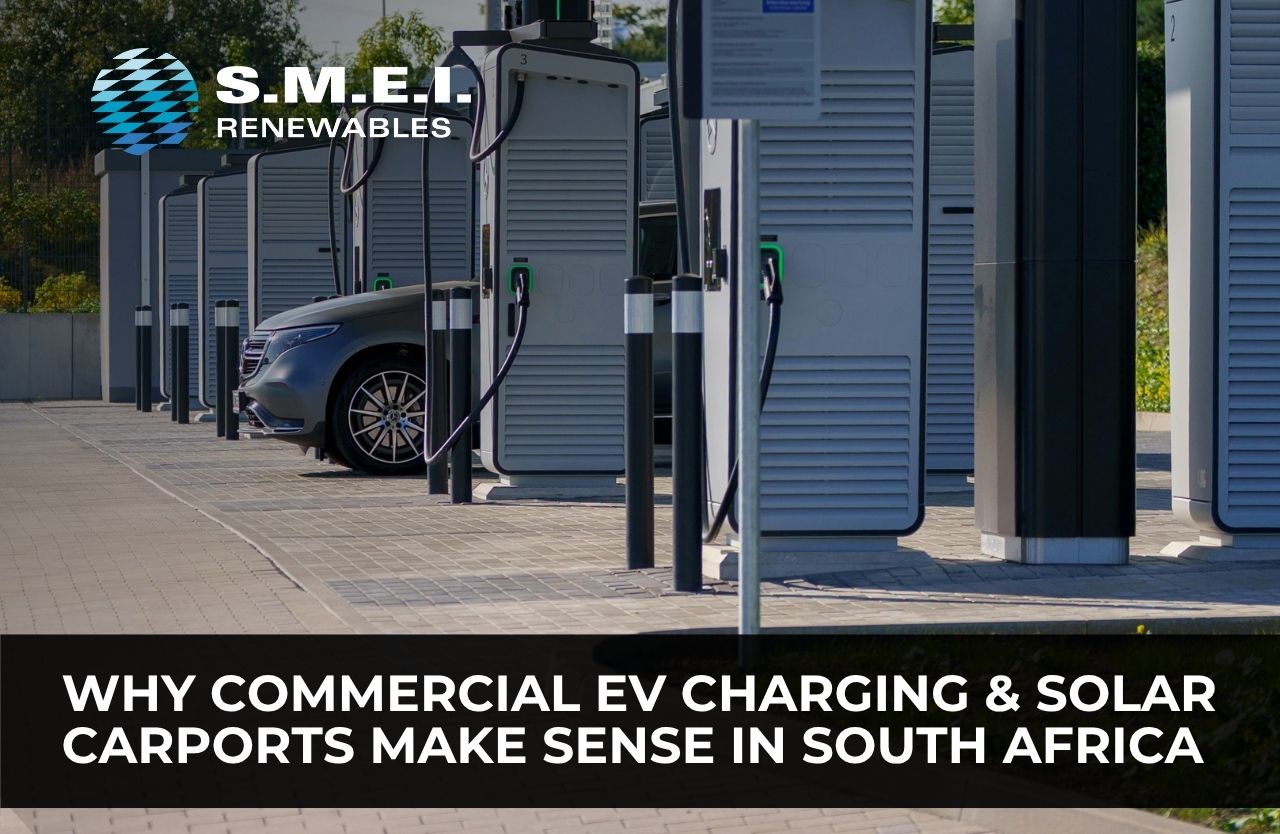
Solar carport with EV charging stations on commercial site

Turning Parking Spaces into Strategic Energy Assets

As South Africa’s commercial property owners and fleet managers grapple with rising electricity costs, load-shedding, and the increasing shift towards electrified transport, a new infrastructure opportunity is emerging: solar carports with EV charging. These structures not only provide shaded parking and protection for vehicles, but also deliver onsite renewable generation, charging infrastructure for EV fleets or visitors, and a clear demonstration of sustainability leadership.

At S.M.E.I. Renewables, we specialise in the design and installation of large-scale solar carport systems that integrate EV charging capabilities – converting parking zones into future-ready energy hubs.

Electric vehicles charging beneath a solar canopy on a commercial parking lot

Why Commercial EV Charging + Solar Carports Make Sense in South Africa

  1. Growing EV adoption + grid volatility

Electric vehicle use in South Africa is still nascent, but growing. The local charging-station network is expanding, and commercial sites need to stay ahead of the curve.

At the same time, load-shedding and high grid tariffs are imposing real cost pressures on commercial operations. Deploying onsite solar generation mitigates this exposure and serves as a strategic hedge.


  1. Optimised use of existing assets

Rather than adding new land or roof structures, car parks offer ideal real estate for solar canopy installations. These turn otherwise passive assets into productive ones. As an example, solar carports can serve dual functions: vehicle shelter + energy generation + EV charging station.


  1. EV charging infrastructure is future-proofing your site

Installing charging stations today positions your facility for the arrival of EV fleets, whether your own trucks, staff vehicles or customer cars. Pairing that with solar means you’ll have renewable supply backing the charging demand. According to industry commentary: “A solar carport canopy is the ideal infrastructure to support electric vehicle (EV) charging… helping future-proof your facilities.” Bluetopsolar


  1. Branding, ESG and revenues

Solar carports signal a visible commitment to sustainability. They may also provide revenue-generating opportunities through visitor EV charging, property differentiation, or even helping tenants/clients align with their ESG goals.


Key Components & Installation Considerations

When you embark on a solar carport + EV charging project, the following areas are critical, and it’s here that S.M.E.I. Renewables’ end-to-end capability makes a difference.


Site selection & feasibility

  • Evaluate the parking area: orientation, shading, traffic flow, structural loading for canopy.
  • Assess solar irradiation, expected yield and estimated energy production from the carport array.
  • Review grid-connection or onsite distribution network capacity, how will the carport tie into your commercial site’s power system?
  • Analyse EV-fleet demand: estimated charging kWh per day/week, time-of-day use, number of chargers required, AC vs DC, vehicle types.


Structural & civil engineering

  • The carport structure must accommodate high-quality modules, weather loads (wind/snow if applicable) and vehicle clearances.
  • Foundations, drainage, surface treatment and site access must be designed for minimal business interruption.
  • At S.M.E.I., our construction teams are experienced in the civil/structural steel aspects of solar carports, ensuring a robust build scheduled around your business operations.


Electrical, mechanical & integration (EC&I)

  • Solar PV array (modules, inverters or optimisers, DC wiring) mounted on the carport roof.
  • EV charging stations installed beneath the canopy, connected to the PV system and/or the main site grid.
  • Power-electronic controls, metering and load-management systems: ensures that solar generation, EV loads and site demand are coordinated for reliability and efficiency.
  • AC-tie-in: The carport system must integrate with your site’s AC distribution, managing harmonics, protection, loads, and grid or micro-grid interactions. S.M.E.I.’s expertise in AC tie-in ensures the solution is engineered to commercial-scale standards.
  • Safety & codes: As commercial installations, the system must comply with South African electrical/regulatory standards and often needs to consider future EV-fleet expansions.

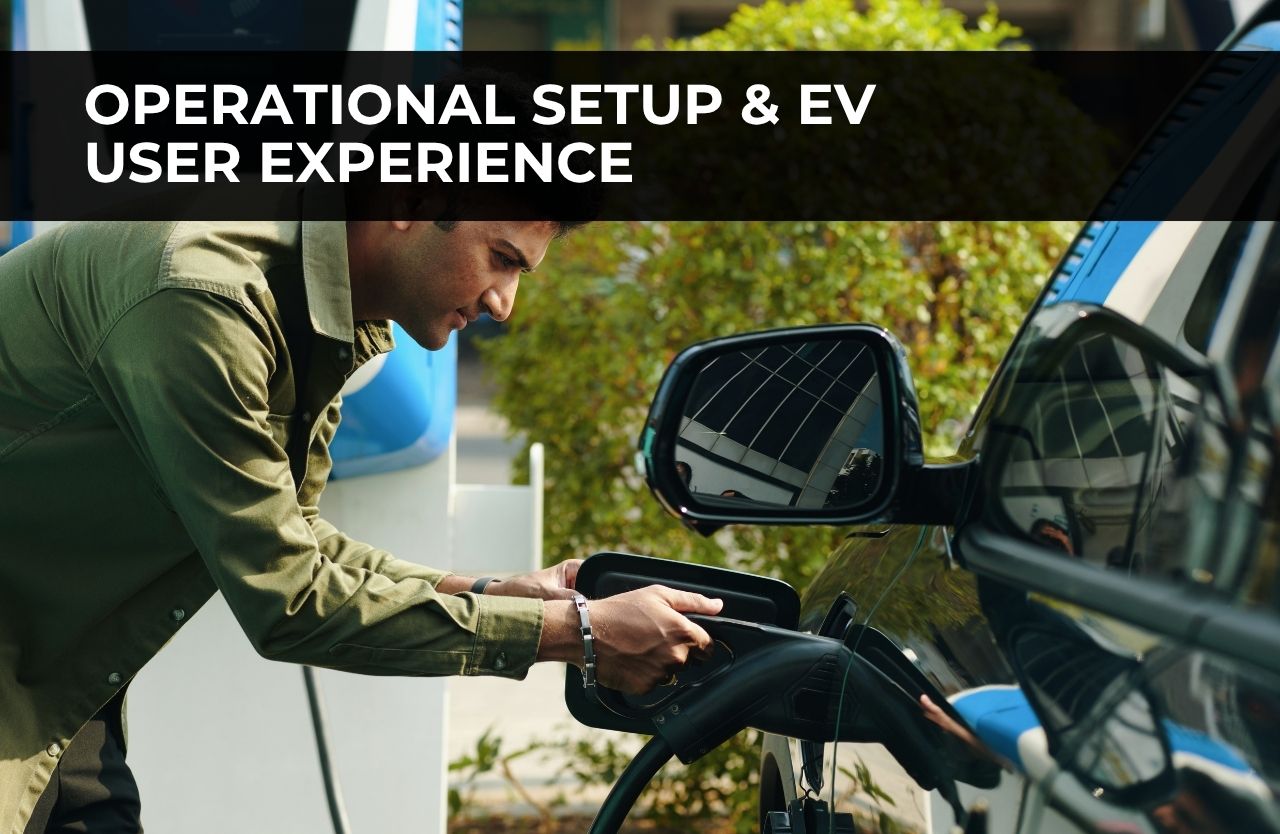
User experience with electric vehicle charging stations

Operational setup & EV user experience

  • Charging infrastructure should support commercial-grade EV fleets or mixed visitor/tenant use.
  • Monitoring systems (for PV output, energy consumption, charger usage) provide data for performance, billing, maintenance.
  • The shading of vehicles beneath the canopy improves user comfort and protects fleets: studies show carports also bring ancillary benefits beyond energy. VPS+1
  • Business model: Consider onsite consumption, PPA (Power Purchase Agreement) for solar generation, fleet charging tariffs, or revenue from visitor charging.


South African Market Snapshot & Local Relevance

  • A well-known South African example: BMW South Africa launched its first solar carport in 2016, supplying an average of 3.6 kW of solar power directly to an EV wall box.
  • Local installers already market commercial carport systems that integrate EV chargers, showing the model is viable in the South African context.
  • The benefits of carport-based solar generation for parking lots have been documented, notably the ability to turn parking areas into revenue-generating green assets.


How S.M.E.I. Renewables Delivers Value

  • End-to-end capability: From feasibility, civil & structural engineering, to PV mounting, EV charger installation, power-electronics and AC tie-in, S.M.E.I. covers the full chain. This reduces interface risk and makes your project timeline cleaner.
  • Commercial-grade installations: We handle large-scale structures, robust canopies, complex flows (fleet charging, mixed-use tenants), and enforce high standards.
  • Future-proof design: We design carport systems with flexibility for expansion (additional EV chargers, battery integration, vehicle-to-grid systems) so your site remains relevant as your EV fleet grows.
  • Local expertise & regional reach: Operating in South Africa and across the SADC region, we understand local procurement, regulations and supply-chain constraints.
  • Quality assurance & performance: We apply engineering and construction standards that ensure durability of the structure, reliability of charging, and return on investment over the life of the asset.


Practical Steps to Get Started

  1. Conduct a parking-audit: how many spaces are available, vehicle type, usage patterns, solar exposure, shutter-load profiles.
  2. Define your EV-fleet roadmap: number and type of EVs, charging requirements, expected growth.
  3. Request a solar carport feasibility study: yield modelling, canopy layout, EV charging infrastructure sizing, tie-in impact to your site power network.
  4. Agree on a technical scope & timeline: structure fabrication, PV installation, charger installation, AC tie-in, commissioning and hand-over.
  5. Review business model options: self-consumption, PPA, charging revenue model, integration with existing energy management systems.
  6. Select a partner with full EC&I capability and proven delivery track-record, that’s where S.M.E.I. Renewables fits.


Conclusion

For property owners and fleet managers in South Africa, the convergence of solar generation and EV infrastructure presents a compelling opportunity. Solar carports don’t just shelter vehicles, they transform parking areas into productive, resilient, future-ready energy hubs. They help control electricity costs, provide onsite charging for electric fleets, enhance ESG credentials and unlock new revenue streams.

By partnering with S.M.E.I. Renewables, you gain access to a robust, end-to-end solution – bridging structure, PV, charging technology and grid integration – so you’re not just ready for today’s EV trend, but positioned for tomorrow’s mobility-driven world.

Contact S.M.E.I. Renewables today to explore how your parking area can become a solar-charged EV asset.

Engineering-Grade Solar Carports: How Custom Designs Maximise Energy and Space

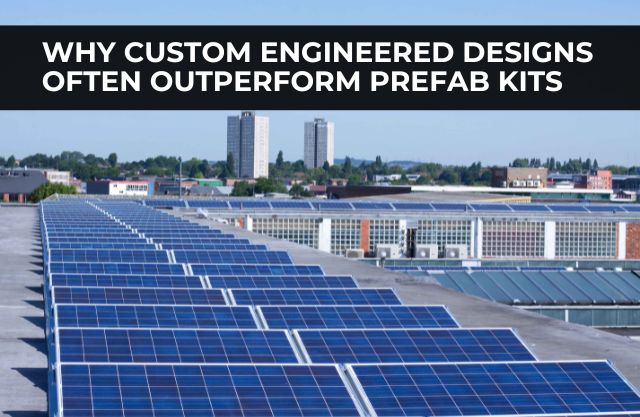
Solar carports offer more than shade or parking cover – when engineered correctly, they become high-performance dual-purpose structures that optimise solar yield, maximise parking area usability, endure harsh weather, and add significant property value. While prefabricated or off-the-shelf kits may look cheaper initially, custom-engineered solar carports unlock gains in energy, safety, longevity, and space utilisation.

What Does “Engineering-Grade” Mean

When we say engineered solar carports, we refer to structures custom designed for a specific site or purpose, with full structural, civil, mechanical, electrical, and aesthetic integration. Key features include:

  • Full structural steel design for load combinations: self-weight, panel weight, dynamic loads (wind, seismic/hail), snow (if applicable), and live loads (vehicle clearance, foot traffic, rain load etc.).
  • Foundations and anchors designed for the specific soil and geotechnical conditions of the site.
  • Steel material selection for strength, corrosion resistance (galvanisation, coatings, etc.), welding quality, fatigue resistance.
  • Integration of solar panel layout, cable routing, inverter placement, drainage, lighting, EV charging or other add on services as may be required.
  • Architectural finishing, aesthetics, alignment with property or site design, pedestrian and/or vehicle access, shade, safety.

Prefab Kits vs Custom-Engineered Solutions: Comparative Trade-Offs

Feature Prefab/Kit Carports Custom/Engineered Carports
Cost (CAPEX) Lower initial purchase cost; standardised forms; minimal design time. But may require adaptation onsite. Higher upfront cost due to engineering, site‐specific foundations, civil works, customisation.
Structural Adequacy & Safety Basic designs that may not account fully for local wind loads, soil conditions, unusual site geometry. Risk of over-engineering or under-engineering. Precisely designed to local standards (wind, seismic, soil), ensuring safety and compliance and reducing risk of damage, insurance claims, or failure.
Solar Yield & Panel Performance Layout may not be optimised: shading issues, sub-optimal tilt or orientation, limited panel count because of prefabricated sizing. Optimised layout for sun path, panel spacing, tilt/azimuth, minimal shading; better cooling and airflow, leading to improved yield.
Space Utilisation & Parking Efficiency Kits may force parking rows, vehicle clearance, circulation that are suboptimal; may waste height or interfere with traffic flow. Custom design adapts to site constraints: circulation, vehicle clearance, efficient column spacing, cantilever designs, height adjustments for large vehicles.
Durability & Maintenance Prefab kits may use lower grade steel, minimal corrosion protection, generic foundations; maintenance may be harder. Engineered steel grades (galvanised, coated), better welding, tailored durability, easier access to components, better maintenance planning. Any adjustments, additions, or repairs can be easily attained and carried out.
Aesthetics & Integration Generic look; limited adaptability to architectural style; possible mismatch with property / urban fabric. More flexibility in finishes, integration of architectural features, branding, visual appeal, matching site lines.
Lead Time & Risk Faster procurement and smaller design time; but higher risk of modification on site, delays due to site mismatch. Longer design phase; but less “surprises” on site; better risk management, more predictable outcomes over lifetime.
Long-term ROI & Value Lower initial barrier; but yield losses, maintenance, shorter lifespan may degrade ROI. Better energy yield, longer lifetime, fewer failures, better property value; often higher IRR over project horizon.

 Here are some of the structural and/or engineering design features that custom, engineered solutions typically incorporate - features that prefab kits often omit or simplify

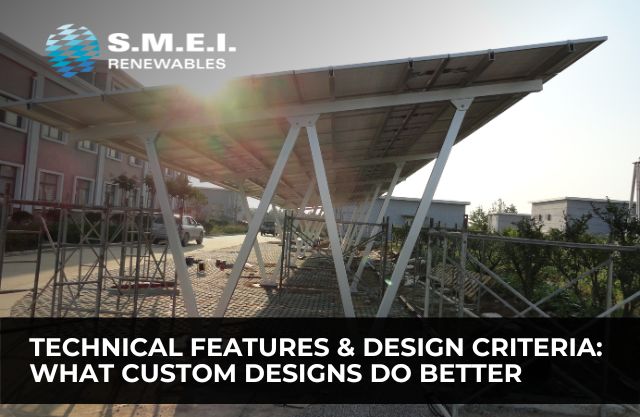
Technical Features & Design Criteria: What Custom Designs Do Better

Here are some of the structural and/or engineering design features that custom, engineered solutions typically incorporate – features that prefab kits often omit or simplify:

1. Steel Material Specification & Corrosion Resistance
  • Use of hot-dip galvanised steel or coated/pigmented protection to resist corrosion especially in coastal, industrial, or high-rainfall areas.
  • Selecting steel sections (I-beams, hollow sections, purlins) sized for local loads and fatigue.
  • Weld quality done to ISO3834, bolt specification (grade, coating), use of stainless or corrosion-resistant fasteners.
2. Foundations / Anchorage
  • Site‐specific geotechnical surveys to determine soil bearing capacity, presence of soft zones, groundwater level.
  • Choosing proper foundation type: drilled piles, strip footings, spread footings, or anchors. If using cantilever or single-post designs, foundations must counterbalance overturning moments.
  • Ensuring anchor bolt design, embedment, and concreting meeting structural code standards.
3. Structural Design for Wind, Snow / Hail, Dynamic Loads
  • Wind load design per local code (South African National Standards, or equivalent), considering gusts, storm events, uplift, vibration.
  • If hail or snow loads apply (less typical in many South African sites but in some local high-altitude zones, hail load matters). Panel impact protection may be necessary.
  • Considering dynamic loading: vibrations, thermal expansions, module weight, etc.
4. Layout & Architecture
  • Optimising layout for panel orientation & tilt to match site latitude, sun paths, avoid shading from adjacent structures, trees, or internal components (columns, conduits).
  • Considering height clearance: to accommodate delivery trucks, vans, or high vehicles if in logistics/commercial property.
  • Circulation lanes, vehicle ingress/egress, pedestrian access, safety, walkways for maintenance.
5. Integration of Additional Features
  • Conduits for wiring neatly integrated, accessible junction boxes, inverter locations, cable trays.
  • Optional features: rainwater gutters, drainage, lighting under carport, EV charging, signage, safety lighting.
  • Aesthetics: clean finishes, colour matching, alignments to urban/architectural design scheme.
6. Maintenance Access & Modularity
  • Designing for maintenance: safe access to panels, cleaning, replacing components, module removal.
  • Modularity allows for extension or modification (e.g. adding more panels or EV chargers) without needing major redesign.
7. Compliance & Certification
  • Meeting South African structural design standards, local building codes, electrical safety standards.
  • Ensuring drawings & QA procedures, steel fabrication quality, material testing, welding inspection, all done in accordance with ISO 3834 and ISO 9001.
  • Insurance and compliance with municipality approvals.

Case Example: Custom Engineered Carport Structures in South Africa / Similar Climates

Schletter SunRide System (South Africa/International): A design based on high-strength hot-dip galvanised steel, with single central supports and cantilevered panels up to 5 m span. The system allows multiple vehicle parking orientations (parallel / herringbone) so parking density is maximised. Foundations are flexible: drilled concrete piles or concrete anchors to minimise excavation impact.

Reduced shading, optimal tilt/azimuth, panel elevation improve yield by a few percent up to 5-10% compared to generic kit layout. Elevated panels are cooler; improved airflow → better efficiency.

Why Custom Engineered Designs Often Outperform Prefab Kits: Quantified Impacts

Here are specific ways custom designs deliver measurable improvements:

Metric Potential Improvement with Engineered Design
Solar energy yield Reduced shading, optimal tilt/azimuth, panel elevation improve yield by a few percent up to 5-10% compared to generic kit layout. Elevated panels are cooler; improved airflow → better efficiency.
Parking efficiency / capacity Better span design, cantilevers or single post supports reduce number of columns or obstructions → more usable parking spaces, easier traffic flow. For example, the cantilever design allows more vehicles parked per area than standard double-row fixed supports.
Structural longevity / lifecycle Proper corrosion protection and steel specification reduce risk of rust / fatigue; better foundations reduce settlement / misalignment. Lifespan maintained; warranty / maintenance costs reduced.
Cost of maintenance / downtime Engineered design reduces unexpected repairs; easier access for component replacement and cleaning; less risk of structural failure or safety compliance failure.

Pitfalls & Things to Watch (And How to Avoid Them)

Even with engineered designs, mistakes are common. Here are pitfalls and how S.M.E.I. Renewables addresses them before we start building a solution.

Pitfall Consequence Mitigation / Best Practice
Under-estimating wind loads or uplift Frame damage, panel damage, safety risk, insurance liability. Use local wind speed data; include safety factors; design for the worst credible wind.
Poor foundation / soil mismatch Settling, misalignment, uneven span, structural stress. Conduct geotechnical study if required; adapt foundation type; use deep piles if needed; proper anchor design.
Corrosion (steel / fasteners) Reduced life; safety risk; higher maintenance; aesthetic degradation. Specify good coatings / galvanising; use suitable fasteners.
Layout/ shading mistakes Reduced energy output; mismatch in row spacing; wasted premium on more panels. Sun path + shading analysis; layout design early; use custom shapes and layouts if site is irregular.
Insufficient height or clearance Hitting vehicles; poor user experience; constraints on traffic flow or future uses (e.g. high vehicle access, EV charging). Define vehicle fleet heights; future-proof for larger vehicles; plan circulation paths.
Poor cable management / safety / code non-compliance Fire risk, safety hazards, unsightly installations, regulatory penalties. Full electrical design; easy access for inspection; conduit trays; proper grounding; follow SA building and electrical codes.

How S.M.E.I. Renewables’ Experience Makes the Difference

Here’s how S.M.E.I. brings engineering, fabrication, and construction excellence to custom solar carports:

  • Steel fabrication capability: In-house or trusted partner fabrication of steel frames, able to produce hot-dip galvanised / corrosion-protected steel, high quality welds.
  • Structural & site engineering: Geotechnical studies, wind load analysis, structural design tuned to site, foundation design adaptively chosen, structural drawings that comply with certification and local building codes.
  • Design integration: We design for panel layout, tilt, orientation, cable routing, inverter siting, EV-charging integration, lighting, drainage etc., working with architects to match aesthetics.
  • Construction management & Quality Assurance: Project schedule optimisation, material quality checks, welding QC, installation alignment, safety, inspections, commissioning, all done in accordance with our ISO 3834, 9001, and 45001 certified standards.
  • Maintenance planning & lifecycle cost modelling: Estimating not just upfront cost, but expected maintenance, component replacement, yield losses due to aging, ensuring that ROI / lifecycle cost is clearly understood.

Practical Decision-Framework for Architects / Developers

When you’re deciding between a simple prefab kit and a custom engineered solar carport, you can run through something like this decision-framework:

  1. Define site constraints: parking lot shape, usable area, height clearance, soil type, climate, exposure to wind, corrosive environment (salt spray, industrial atmospheres), vehicles types.
  2. Define energy goal & yield requirements: how much energy do you need the carport to offset (percentage of daytime load, PPA obligations, EV charging)? What tilt/orientation maximise that?
  3. Define design / aesthetic goals: How important is appearance? Integration with architectural style, signage, colouring, branding, lighting etc.
  4. Estimate CAPEX vs Lifecycle Value: Cost of structure + solar system + foundations + installation vs yield over 20-25 years, maintenance costs, downtime, insurance, resilience.
  5. Risk assessment: weather, structural failure, corrosion, shading, damage, maintenance accessibility.
  6. Supplier & fabrication capability check: Does your vendor have experience with structural steel, custom design, QA/QC, in-house steel fabrication or trusted partners, ability to warranty, supply chain local / imported.

Conclusion

Custom-engineered solar carports consistently outperform prefab kits in every area that matters – energy yield, safety, durability, space utilisation, aesthetics, and long-term value. For commercial developments such as retail centres, logistics hubs, campuses, or mixed-use properties, a well-designed carport does far more than provide shade: it generates measurable energy savings, enhances property value, and improves the user experience with features like integrated EV charging.

With proven expertise in steel fabrication, structural engineering, and full construction management, S.M.E.I. Renewables ensures that solar carports are not just shelters, but high-performance assets built to last.

Solar Carports in 2025: More Than Just Shade – They Power Business Performance

Solar carports offer shade and protection for vehicles and generate electricity, pairs of benefits that deliver strong ROI. Below is an overview of what to know in 2025, with insights, numbers, and how S.M.E.I. Renewables can help.

As energy costs rise, load shedding continues, and corporate sustainability becomes non-negotiable, solar carports are fast becoming a dual-purpose investment for retail, logistics, and commercial property managers in South Africa. Solar carports offer shade and protection for vehicles and generate electricity, pairs of benefits that deliver strong ROI. Below is an overview of what to know in 2025, with insights, numbers, and how S.M.E.I. Renewables can help.

What are Solar Carports & Why They’re Relevant Now

A solar carport is a carport with a roof that is made up of or supports photovoltaic (PV) panels. The structure supplies the dual function of protecting parked vehicles from the elements (sun, rain, etc.) while also generating electricity to offset grid consumption, reduce utility bills, and improve energy self-sufficiency.

With worsening grid reliability and rising electricity tariffs, businesses are looking for ways to stabilise energy costs, reduce exposure to load shedding, and meet sustainability targets. Solar carports allow property managers to use otherwise under-utilised parking space as a revenue-generating asset.

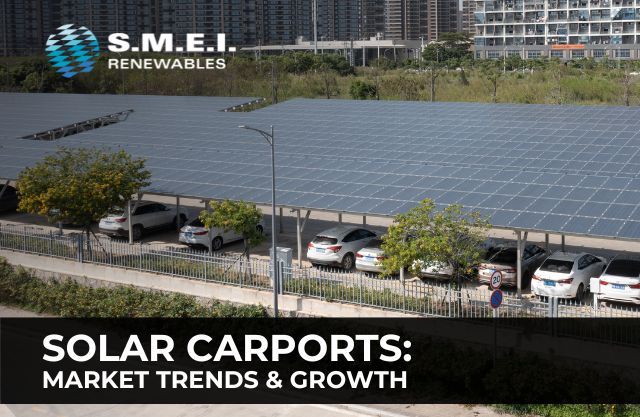
Market Trends & Growth

Here are a few recent trends relevant to solar carports in South Africa:

  • The solar carport market in South Africa was worth about US$12.0 million in 2024, and is projected to reach US$28.8 million by 2033; that implies a compound annual growth rate (CAGR) of roughly 10.3% between 2025-2033.
  • Types of carports gaining popularity include T-shape and semi-cantilever designs. T-shape was the largest revenue-generating type in 2024; semi-cantilever is the fastest growing segment.
  • Local suppliers like S.M.E.I. Renewables offer mounting structures in galvanised or painted structural steel with flexible structural configurations to suit site constraints.

Costs, ROI & What Drives Value in South Africa

To evaluate whether a solar carport makes financial sense, you need to understand costs, savings, and local factors. Recent data shows many businesses can expect to recoup costs in 5-10 years, depending on electricity tariff, average sunlight, shading losses, and how much of their demand the carport offsets.

Other ROI enhancers include:

  • Incorporating EV charging under the carport, which adds value and meets future mobility trends.
  • Using high-efficiency panels, good mounting (minimise shading), and ensuring orientation to maximise yield.
  • Leveraging property tax incentives, rebates, or savings from avoided energy purchases.

Key Considerations for Property & Logistics Managers

To maximise business performance from solar carports, attention to the following is essential:

  • Orientation, shading, height & structural strength: Carports need enough height so vehicle access isn’t restricted; shading must be minimised for good solar output; structure must be engineered for local wind, snow/hail loads.
  • Electrical integration: The balance between self-consumption vs feeding into grid; whether EV charging is included; permitting, metering, safety interlocks.
  • Maintenance: Access to cleaning panels, replacing components, managing corrosion (especially in coastal or industrial atmospheres).
  • Permits and regulation: Local building permits, electrical safety codes, possible zoning constraints. Potential incentives or tax breaks.
  • Financial modelling: Include lifetime costs (panels, inverters, structure), expected energy output, tariff inflation, savings, depreciation. Also factor in potential for future demand growth (e.g. adding EV charging stations).

How S.M.E.I. Renewables Supplies & Installs Premium Solar Carports

Here’s how S.M.E.I. Renewables adds value to every solar carport project, making sure the dual purpose investment really delivers:

  • Full end-to-end service: From site assessment, structural and electrical design, sourcing of high-quality panels & mounting systems, through to installation, commissioning, and ongoing maintenance.
  • Custom design options: Ability to tailor design (material, form, size, EV integration) to match the aesthetic and operational needs of commercial, retail or logistics properties.
  • Quality & standards: Use of Tier 1 PV modules, certified structural materials, compliance with local electrical and safety codes.
  • Experienced project execution: Using local supply chains (e.g. for mounting structure, panels), ensuring strong timelines, safety & warranty.
  • ROI focused modelling: Helping clients understand payback periods, savings, cash flow, tax / incentives, long-term value (property value, energy independence) from carport installations.

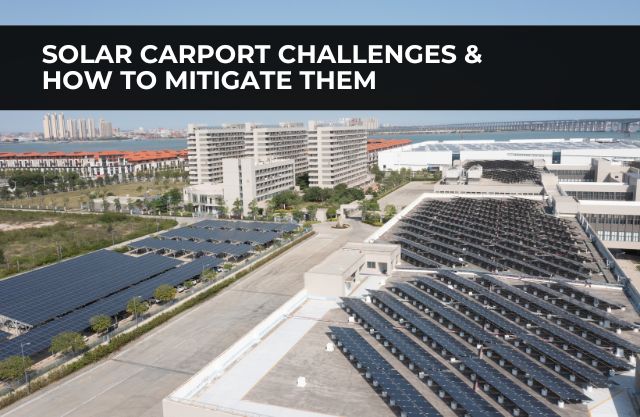
Challenges & How to Mitigate Them

Even though solar carports are compelling, there are obstacles. Here are some of the more common ones, and how S.M.E.I. helps to address them:

  • Capital upfront cost: Carport + panels + electrical + foundation + permits add up. Mitigation: phased installations, financing options, or PPAs, or cost sharing among tenants.
  • Efficiency losses: Shading, suboptimal orientation, dust/soiling. Mitigation: good design, regular cleaning and maintenance, elevated roof designs, choosing durable materials.
  • Permitting delays & local regs: Can slow projects. Mitigation: leveraging local expertise, early engagement with municipality, ensuring compliance to building / electrical codes.
  • Structural & environmental constraints: Soil, height constraints, wind/hail risk. Mitigation: custom structural engineering; selecting materials suitable for environment; doing geotechnical and environmental impact assessments as needed.

Conclusion: Why Solar Carports Are Smart Business in 2025

Solar carports in South Africa are no longer a novelty. They are a practical, value-adding asset: generating power, increasing property appeal, improving sustainability credentials, and protecting vehicles. For retail centres, logistics depots, commercial properties with large parking lots, they offer one of the highest return per square metre of under-utilised space.

When done well, with the right design, quality materials, and efficient installation – solar carports can deliver solid ROI (often in 5-10 years), boost business performance, reduce exposure to tariff hikes and load shedding, and support sustainability.

If you’re considering solar carports and want them designed, built, and maintained to deliver both shade and serious energy value, S.M.E.I. Renewables is well positioned to help.

Contact us to explore a customised solar carport solution that aligns with your budget, site, and energy goals.

Global Innovations and South African Firsts: A Two-Way Influence

South Africa has been the trailblazer pioneering breakthroughs that later spread globally. In other cases, ideas born internationally have been adopted and advanced within South Africa.

Introduction

Throughout history, innovation and progress have often been a two-way street between South Africa and the rest of the world. In some cases, South Africa has been the trailblazer pioneering breakthroughs that later spread globally. In other cases, ideas born internationally have been adopted and advanced within South Africa. This dynamic interplay is evident across diverse fields, from medicine and technology to energy and policy. In this blog, we explore several notable examples of this exchange, focusing on which came first – whether South Africa led with a first-of-its-kind innovation that influenced the world, or whether South Africa leaned on concepts pioneered elsewhere, adapting them to local needs. Each example illustrates how knowledge and innovation transcend borders, ultimately benefiting global society.

On December 3, 1967, Dr. Christiaan Barnard and his team in Cape Town performed the world’s first human-to-human heart transplant at Groote Schuur Hospital.

Pioneering Medical Breakthrough: The First Heart Transplant

One of the most famous examples of South African innovation influencing the world is the first human heart transplant. On December 3, 1967, Dr. Christiaan Barnard and his team in Cape Town performed the world’s first human-to-human heart transplant at Groote Schuur Hospital. This groundbreaking operation in which patient Louis Washkansky received a donor heart stunned and inspired the global medical community. Notably, the surgical techniques Barnard used had been developed by researchers in the United States during the 1950s. In other words, the idea of transplanting a heart was born abroad (pioneered by Dr. Norman Shumway’s experiments at Stanford, among others), but South Africa was the first to turn that idea into reality on a human patient. The successful surgery, although the patient survived only 18 days, proved that heart transplantation was possible and paved the way for improvements in immunosuppressive therapy in the 1970s. After this South African first, heart transplants gradually became viable around the world as surgical techniques and anti-rejection drugs improved. Dr. Barnard’s feat influenced cardiac surgery globally – by the late 1970s, many patients worldwide lived years with transplanted hearts, an outcome made possible in part by the trail first blazed in Cape Town. This example shows how a medical idea originating elsewhere achieved its first full realisation in South Africa, sparking a leap forward internationally.

Revolutionising Telecom: Prepaid Mobile Phones

In the 1990s, South Africa again took the lead in innovation – this time in telecommunications – with the advent of prepaid mobile phone service. The concept of prepaid cell service (pay-as-you-go mobile plans) arose globally as a way to extend phone access to those without credit or bank accounts, and early trials were conducted in the United States and Europe in the early 1990s. However, it was South African operator Vodacom that became the first network in the world to launch a successful prepaid mobile product. In November 1996, Vodacom introduced its “Vodago” prepaid package using an intelligent network platform that allowed real-time billing of airtime. This innovation proved transformative – by eliminating the need for contracts or credit checks, it opened mobile access to millions of new customers. The impact was immediate: Vodacom’s prepaid service led to a dramatic surge in mobile uptake in South Africa, and it earned a “Best GSM Service” award from the GSM Association in 1998 for this world-first achievement.

The success in South Africa quickly inspired operators around the globe. By the late 1990s, the prepaid model had been copied in virtually every country in Europe and beyond, rapidly becoming the dominant mode of mobile service in many markets. In developing countries especially, pay-as-you-go plans soon accounted for the overwhelming majority of mobile subscriptions. What began as a South African first – informed by earlier international ideas on broadening phone access – ended up revolutionising the global telecom industry. Today, prepaid mobile options remain a staple worldwide, highlighting how an innovation implemented first in South Africa helped accelerate global connectivity.

South Africa has also been at the forefront of innovative climate and energy policy in ways that both draw on global ideas and set new precedents. Globally, the urgency of transitioning to renewable energy has been driven by international scientific consensus and agreements.

Leading Climate Action: South Africa’s Just Energy Transition

In recent years, South Africa has also been at the forefront of innovative climate and energy policy in ways that both draw on global ideas and set new precedents. Globally, the urgency of transitioning to renewable energy has been driven by international scientific consensus and agreements. For instance, the International Renewable Energy Agency (IRENA) reports that total renewable power capacity worldwide surged from about 1,700 GW in 2014 to nearly 3,870 GW in 2023 – a reflection of rapid global adoption of wind, solar, and other clean technologies. This momentum aligns with calls from bodies like the IPCC for a drastic emissions reduction by 2030. South Africa, historically reliant on coal for roughly 80% of its electricity, has been under pressure to shift course as part of this global energy transition.

South Africa’s response drew inspiration from international climate finance concepts but also broke new ground. At the UN COP26 climate conference in 2021, President Cyril Ramaphosa announced the Just Energy Transition Partnership (JETP) – a landmark deal in which a coalition of major nations (France, Germany, the UK, the US, and the EU) pledged an $8.5 billion package to support South Africa’s shift from coal to renewable energy. This JETP was hailed as a “first-ever, internationally applauded decarbonisation programme” – essentially a pilot model for how a developed-developing country partnership could facilitate a fair energy transition in a coal-dependent, middle-income economyecdpm.org. In this case, the idea of developed countries financing developing nations’ green transition was discussed globally for years, but South Africa became the first to implement it at scale, crafting a country-led plan to retire coal plants in exchange for climate finance. The influence has been immediate: South Africa’s JETP has become a template for other nations. By 2022-2023, similar partnership deals were announced for Indonesia ($20 billion) and Vietnam ($15.5 billion), among others, with lessons explicitly being drawn from South Africa’s experience as the first JETP recipient. In short, South Africa leaned into a global climate idea and turned it into an actionable program that is now guiding other countries’ transitions.

South Africa’s leadership in renewable energy isn’t limited to finance. The country also pioneered a competitive approach to procuring green power. In 2011, the government launched the Renewable Energy Independent Power Producer Procurement Programme (REIPPPP) to attract private investment in wind, solar, and other renewables. This initiative was introduced at COP17 in Durban and aimed to diversify South Africa’s coal-heavy energy mix in line with global climate commitments. By 2023, REIPPPP had successfully commissioned about 6,200 MW of renewable capacity (around 5% of South Africa’s supply) and mobilised R256 billion in private investment. Despite some delays, the program’s early rounds were so successful and transparent that REIPPPP came to be viewed as a model for other African nations looking to develop renewables. In fact, much of the anticipated growth in South African power over the next decade – nearly 9 GW of new capacity by 2032 – is expected to come from non-hydro renewables driven by REIPPPP and policy reforms. Here again, global ideas (like renewable auctions and feed-in tariffs, pioneered in countries such as Brazil and Germany) informed South Africa’s approach, but South Africa’s execution in the African context set an example that has influenced energy policy across the continent.

Conclusion

From these examples, a clear picture emerges: innovation is a global conversation, and South Africa has been an active and sometimes leading voice. When South Africa has been first – whether transplanting a human heart or rolling out prepaid mobile telephony – it has often demonstrated what is possible, providing a proof of concept for the rest of the world. Conversely, when South Africa has adopted ideas originating elsewhere – be it surgical techniques, telecom solutions, or climate finance models – it has added its own momentum and adaptations, showing how global concepts can take root in local soil. The exchange has enriched both sides. South African breakthroughs have saved lives and connected people worldwide, while international innovations have helped South Africa address local challenges from healthcare to energy. This continual exchange underlines our shared progress: what starts in one place can inspire many, and tackling big challenges often requires learning from each other’s firsts. In a rapidly changing world, the story of global and South African innovation reminds us that leadership in ideas knows no fixed address – it belongs to all who are prepared to pioneer and to learn, regardless of where they stand on the map.

Sources

  • History.com Editors. “First human heart transplant.” History, updated May 27, 2025 history.comhistory.com.
  • Wikipedia. “History of prepaid mobile phones” (section on early implementations) en.wikipedia.orgen.wikipedia.org.
  • Statzon Insights (via IRENA data). “IRENA’s Report Calls for a Tripled Renewable Power Capacity by 2030.” Karri Takki, May 2, 2024 statzon.comstatzon.com.
  • EngineerIT. “CSIR releases 2022 statistics on power generation in SA,” Feb 23, 2023 engineerit.co.zaengineerit.co.za.
  • U.S. Trade.gov. “South Africa – Energy (Country Commercial Guide),” last published Jan 26, 2024trade.govtrade.gov.
  • ECDPM. “Two years into South Africa’s Just Energy Transition Partnership: How real is the deal?” Jan Vanheukelom, Nov 27, 2023 ecdpm.org.
  • IISD/jetknowledge.org. “Seven Things Indonesia Can Learn From South Africa’s JETP,” Anissa Suharsono, Nov 7, 2023 jetknowledge.org.

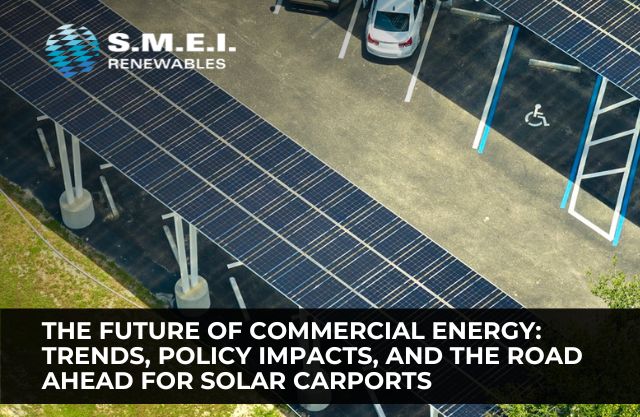
The Future of Commercial Energy: Trends, Policy Impacts, and the Road Ahead for Solar Carports

In the rapidly evolving landscape of commercial energy, solar carports are fast becoming more than just covered parking. They are transforming into multifunctional energy assets that support smart grid integration, electric vehicle (EV) infrastructure, and corporate sustainability goals.

In the rapidly evolving landscape of commercial energy, solar carports are fast becoming more than just covered parking. They are transforming into multifunctional energy assets that support smart grid integration, electric vehicle (EV) infrastructure, and corporate sustainability goals. As technology accelerates and policies shift to meet climate commitments, the future of solar carports is poised to reshape the commercial property sector across South Africa, the African continent, and globally.


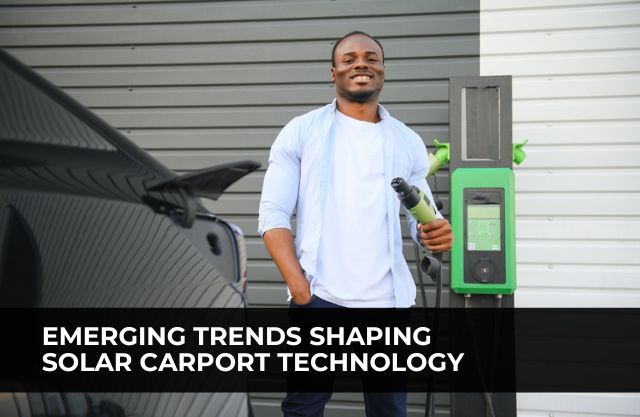
Emerging Trends Shaping Solar Carport Technology

1. Integration with Smart Grids and IoT

The future of solar carports lies in their role within interconnected energy ecosystems. Smart grid integration allows these structures to do more than just generate electricity—they can respond dynamically to demand, provide ancillary grid services, and support decentralised energy management.

Paired with IoT (Internet of Things) technology, solar carports are now equipped with real-time performance monitoring, predictive maintenance alerts, and smart load balancing features. These advancements enable businesses to maximise uptime, reduce energy waste, and cut operational costs.

2. Next-Generation Panel Technology

Innovations such as bifacial panels, which capture sunlight from both sides, and thin-film solar modules are improving the efficiency and flexibility of carport installations. These advancements allow for higher yield and more adaptable designs, including carports with architectural curves or integrated branding.

The future of solar carports lies in their role within interconnected energy ecosystems. Smart grid integration allows these structures to do more than just generate electricity—they can respond dynamically to demand, provide ancillary grid services, and support decentralised energy management.

3. EV Charging and Hybrid Infrastructure

As EV adoption increases across South Africa and Africa, solar carports are expected to integrate EV charging as a standard feature. This turns a parking lot into a clean energy mobility hub—offering convenience, reducing grid load, and supporting national electrification goals.


Policy Impacts and Market Momentum

South African and African Context

Since 2021, the commercial and industrial (C&I) solar sector in South Africa has grown rapidly, supported by relaxed licensing regulations and a desperate need for energy resilience amid ongoing load-shedding. By 2022, over 1.2 GW of C&I solar had been installed, with reports of up to 100 new commercial-scale solar projects being initiated daily across Africa.

Tax incentives such as South Africa’s Section 12B and 12BA deductions allow businesses to write off the cost of solar carport installations—up to 125% in some cases. However, long-term growth still depends on regulatory stability, streamlined permitting, and a reliable utility grid that can accommodate distributed generation.

Global Benchmarks Driving Innovation

Europe continues to lead with aggressive policy support. Italy and France’s “Superbonus 110%” programmes have made solar carports virtually free to commercial property owners by covering installation costs beyond 100%. Spain’s Royal Decree on self-consumption and additional regional grants have pushed widespread adoption.

These policy environments highlight what’s possible—and necessary—for accelerating solar infrastructure adoption. For Africa, the roadmap includes reducing the cost of capital, managing currency risk, and ensuring transparent procurement processes to attract sustainable investment.


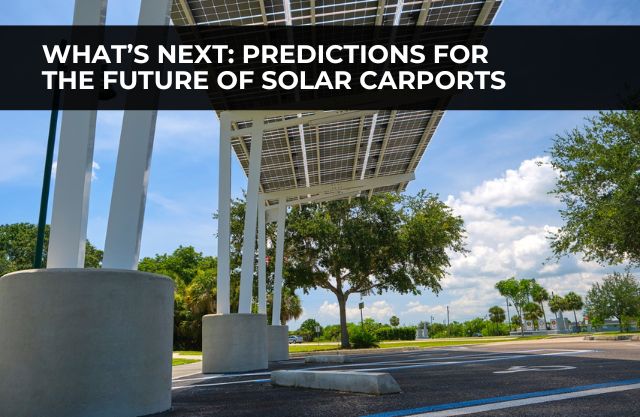
What’s Next: Predictions for the Future of Solar Carports

1. Energy Storage Becomes Standard

Battery integration will no longer be optional. Solar carports equipped with energy storage systems will allow businesses to store excess daytime power for night use or grid outages, improving resilience and lowering peak-time energy costs.

2. Grid Participation and Revenue Generation

Commercial carports will serve as energy resources for smart grids. Businesses will participate in demand response programmes, sell excess energy via net metering, and potentially earn from providing grid-balancing services—all from their parking lots.

3. Building Green Infrastructure for Smart Cities

Solar carports are increasingly seen as key enablers of sustainable urban development. Their ability to generate clean power while using already-developed land aligns perfectly with smart city principles. Expect to see more urban developments mandating solar carport integration to meet energy and mobility needs.

4. Data-Driven Sustainability Leadership

With smart monitoring systems, solar carports will offer real-time emissions tracking, energy performance dashboards, and maintenance insights—empowering sustainability officers with the tools to meet ESG targets and communicate progress to investors and customers.


The African Opportunity

With abundant solar resources and a growing demand for energy independence, Africa is well positioned to leapfrog into the future of solar carports. South Africa, in particular, has the industrial capability and policy momentum to become a continental leader in smart, grid-connected commercial solar carport installations.

As governments improve incentives and streamline regulations, we can expect the next wave of solar carport innovation to emerge not just from global tech hubs, but from right here in Africa.


Conclusion

The future of solar carports is dynamic, integrated, and critical to sustainable commercial development. As they evolve into intelligent infrastructure assets, solar carports will drive down costs, reduce emissions, and build resilience in an increasingly volatile energy landscape.

For forward-looking businesses, investing in premium, future-ready solar carports isn’t just a smart move—it’s a strategic imperative.

CTA: Ready to future-proof your commercial property with solar carport technology? Contact S.M.E.I. Renewables today to discuss a solution tailored to your long-term sustainability goals.

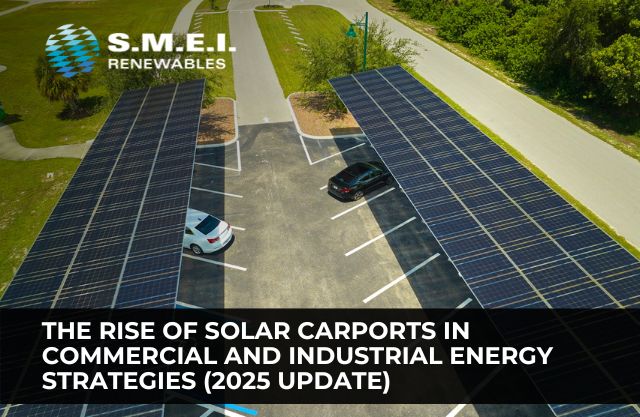
The Rise of Solar Carports in Commercial and Industrial Energy Strategies (2025 Update)

As commercial and industrial properties race to meet sustainability targets and reduce operational costs, solar carports are emerging as a powerful, multi-functional clean energy solution. From shopping centres and office parks to factories and educational campuses, these structures are transforming underutilised parking areas into high-performance energy assets.

As commercial and industrial properties race to meet sustainability targets and reduce operational costs, solar carports are emerging as a powerful, multi-functional clean energy solution. From shopping centres and office parks to factories and educational campuses, these structures are transforming underutilised parking areas into high-performance energy assets.

Why Solar Carports Are Surging in Popularity

Recent global market research (March–June 2025) reveals a compound annual growth rate (CAGR) of 9.78% to 16.5% projected through 2034. The commercial sector leads adoption, representing up to 76% of installations globally. The primary appeal? Solar carports deliver dual value: shaded, climate-resilient parking and reliable renewable energy generation.

At a time when corporate ESG (Environmental, Social, Governance) accountability is non-negotiable, solar carports provide a highly visible, functional testament to sustainability. They not only reduce electricity bills and carbon footprints, but also showcase a company’s commitment to clean energy—a narrative that resonates with clients, investors, and employees alike.

One of the most significant developments in 2025 is the rise of solar carports as full-fledged clean energy hubs. Paired with battery energy storage systems (BESS) and EV charging stations, carports now offer a wide variety of benefits.

Integration of Energy Storage and EV Charging

One of the most significant developments in 2025 is the rise of solar carports as full-fledged clean energy hubs. Paired with battery energy storage systems (BESS) and EV charging stations, carports now offer:

  • 24/7 clean energy access, including during peak demand periods
  • Power resilience during grid outages
  • On-site EV charging to support employee fleets or public infrastructure

This triple integration dramatically enhances operational efficiency, supports ESG reporting, and unlocks potential revenue through grid participation and EV charging tariffs.

Breakthroughs in Solar Technology

Advanced solar panel innovations are redefining what’s possible for solar carport performance:

  • Bifacial panels, which absorb light from both sides, boost generation by up to 30%.
  • Perovskite and thin-film technologies offer lighter, flexible alternatives that broaden installation options, including curved surfaces and vertical integration.
  • Building-integrated photovoltaics (BIPV) enable design-forward projects with seamless solar integration.

These advancements reduce the levelised cost of energy (LCOE) and increase long-term ROI for businesses.

Smart Carports: AI and IoT for Maximum Efficiency

The fusion of solar carports with AI and IoT is setting new benchmarks in efficiency and transparency. Commercial users can now:

  • Monitor panel output and battery levels in real-time
  • Predict weather impacts and adjust energy storage dynamically
  • Automate system maintenance and performance alerts

These capabilities significantly reduce downtime, extend system life, and ensure optimal performance year-round.

Design Innovations and Engineering

Design flexibility has also evolved:

  • T-shape carports dominate with 42% of market share in 2024, prized for space efficiency and solar optimisation
  • Custom-engineered solutions allow for wind and snow loads, specific guardrails, uneven terrain, and local aesthetic or height requirements

Smart engineering ensures that carports enhance the site without disrupting operations—essential for logistics, retail, or manufacturing environments.

Key Considerations for Implementation

For commercial and industrial stakeholders planning a solar carport installation, three areas require careful navigation:

  1. Site Assessment: Tailored layout, structural analysis, and solar orientation
  2. Permitting & Incentives: Compliance with local regulations and leveraging available tax breaks or subsidies
  3. Grid Compatibility: Integration with existing energy systems and potential for smart grid services

In South Africa, tax deductions for renewable energy investments and a push toward decentralised energy supply are paving the way. Across Africa, lower capital costs and improved currency hedging will be critical to unlocking widespread adoption.

Sector and Regional Momentum

Key sectors accelerating adoption include:

  • Retail & Shopping Centres: Aligning sustainability with customer experience
  • Industrial Complexes: Reducing grid dependency and stabilising energy costs
  • Educational Institutions: Supporting green campus initiatives and powering digital infrastructure

While the U.S., Canada, and Europe lead in terms of policy support and volume, Africa is gaining momentum. With abundant solar resources and pressing energy security concerns, the continent’s commercial solar carport potential is vast and still largely untapped.

Summary Table: Key Trends and Considerations

Trend/Consideration Details & Impact
Market Growth 9.78–16.5% CAGR; commercial sector leads with 76% share
Energy Storage & EV Integration Solar + storage + EV charging for 24/7 clean energy and resilience
Advanced Solar Technologies Bifacial, perovskite, and thin-film panels increase efficiency and application flexibility
Smart Systems AI/IoT for real-time monitoring, predictive optimization, and cost reduction
Design Innovations T-shape and custom-engineered carports for space and energy maximization
Permitting & Incentives Critical for project success; varies by region
Urban & Industrial Applications Ideal for dense areas, turning parking into energy assets, supporting ESG and climate goals


Final Word: Solar Carports Are More Than a Trend

Solar carports are no longer a futuristic concept—they are a strategic investment with immediate and long-term payoffs. As technology advances, costs decrease, and demand for clean energy intensifies, solar carports will become the cornerstone of commercial energy infrastructure.

For property owners and decision-makers, the time to act is now. Investing in solar carports is more than just smart energy management; it’s a visible, scalable, and resilient solution that positions your business for the energy landscape of tomorrow.

Get in touch with S.M.E.I. Renewables to discuss your next big power move.

Solar Carports vs Rooftop Solar: Smart Investment Guide

Aerial view of a large commercial parking area covered with solar carports, positioned beside industrial buildings. The image illustrates the comparison between solar carports and rooftop solar for business energy solutions.

Investing in renewable energy isn’t just a trend — it’s a business imperative. For South African companies weighing solar carports vs rooftop solar, ground-mounted farms, or energy-efficient upgrades, the decision can be complex. Solar carports are fast becoming a preferred choice for businesses with the right space, offering visibility, environmental impact, and dual-purpose use. But how do they stack up against other clean energy options?
In this article, we compare solar carports to alternative clean energy solutions and explore how visibility, scalability, and long-term ROI factor into a smart sustainability strategy.

Solar Carports vs. Other Clean Energy Investments

When strategising sustainability investments, companies often compare options like rooftop solar panels, ground-mounted solar farms, and energy-efficient building upgrades. Solar carports bring a unique mix of benefits to the table, but it’s useful to see how they stack up against other common clean energy approaches:

  • Rooftop Solar vs. Solar Carports: Both rooftop and carport solar PV systems generate clean electricity on-site, but they differ in placement and visibility. Rooftop solar is typically constrained by the available roof area, roof orientation, and structural capacity of the building. If a facility’s roof is small, shaded, or cannot support the weight of panels, a carport offers an alternative by utilising open parking space. Rooftop installations usually have a lower cost per kW since the building structure is already in place; by contrast, carports incur extra costs for steel canopies and foundations. (One U.S. analysis noted that solar carports can be slightly more expensive due to the added structure​.) However, carports provide additional value by shading vehicles and are highly visible to stakeholders. A solar array on a roof might go unnoticed, but a solar carport is immediately apparent to employees, customers, and passersby – effectively advertising the company’s green commitment. In terms of performance, both systems can be designed for optimal tilt and orientation to maximise generation; carports actually allow more freedom in panel orientation than roofs fixed to a building’s layout. Many companies opt to do both: install rooftop PV where it fits and add carports to further expand capacity once the roof is maxed out. 
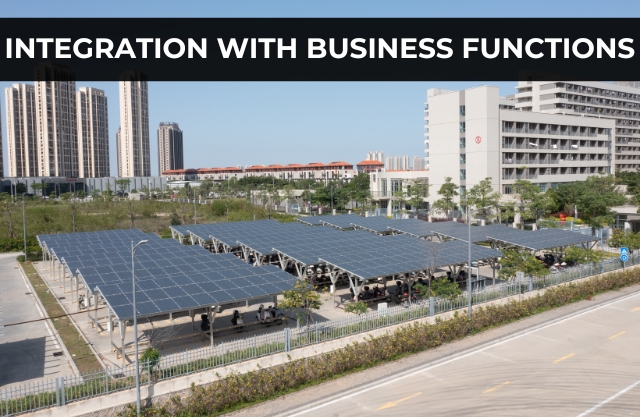
  • Solar Farms (Ground-Mount) vs. Solar Carports: Large ground-mounted solar farms (either on-site if land is available, or off-site with power wheeled to the facility) can achieve economies of scale and often the lowest cost per kWh for solar. They are ideal for utility-scale generation or for organisations with significant open land. However, not every business has spare land adjacent to its operations – especially in urban or industrial areas where space is at a premium. Solar carports make use of an existing asset (parking lots), meaning no extra land is required. While ground mounts might slightly edge out carports in pure cost efficiency, carports double as infrastructure for the business (providing sheltered parking), thereby improving land-use efficiency. They also integrate more directly with the facility’s power usage (being right on-site, reducing transmission losses). In terms of scalability, a solar farm can be built as large as needed if land permits, whereas carports scale with the parking area. For many South African businesses, parking lots represent an untapped resource for solar – a mid-sized carport array can often generate a few hundred kilowatts to multiple megawatts, which significantly offsets a facility’s consumption without needing new real estate. Moreover, solar farms hidden in remote fields don’t garner public attention for the company, whereas a solar carport on your premises is a daily billboard of sustainability. Finally, solar carports can be integrated with EV charging stations more naturally in a parking context, something standalone solar farms can’t do on their own. 
  • Energy-Efficient Lighting vs. Solar Carports: Upgrading to LED lighting and high-efficiency equipment is a classic sustainability measure focused on reducing energy demand. Solar carports, on the other hand, focus on increasing clean energy supply. In practice, the best strategy is to do both – cut unnecessary energy use and then supply the rest with renewables. Energy-efficient lighting (like LEDs, smart controls, motion sensors) often has a quick payback and low upfront cost, making it a low-hanging fruit for CSR goals. However, its overall impact on a large facility’s carbon footprint may be modest – lighting might constitute only a fraction of total electricity usage. A solar carport involves a larger investment but can offset a much bigger chunk of grid consumption. In terms of cost and footprint, LEDs improve the internal environment (better light quality, lower heat load) without requiring additional space, whereas a carport is a noticeable physical addition. One advantage of efficiency projects is that they typically don’t require regulatory approvals or engineering of new structures, while solar carports do involve design and construction. That said, solar carports often attract more positive attention. An LED retrofit is invisible to outsiders, but a field of solar panels in your parking lot is a highly visible symbol of innovation. Both approaches are complementary: efficiency measures reduce the size (and cost) needed for a solar installation, and the solar carport then covers the optimised load with clean energy. Companies balancing their sustainability portfolio should invest in efficiency first (to eliminate waste) and then in generation like solar carports to cleanly power the remaining needs.

Solar carports compare very favourably with other green investments, particularly for companies with large parking areas and a desire for a high-profile sustainability project. They may carry a somewhat higher upfront cost than a simple rooftop array, but they deliver multi-faceted returns – energy, environmental, social, and practical (shade and comfort). By combining solar carports with other solutions (efficient appliances, rooftop panels, etc.), businesses can compound their gains and move rapidly toward both cost savings and carbon neutrality.

View of a modern solar carport installation over a busy commercial parking lot, showcasing how businesses can enhance sustainability visibility and stakeholder confidence through on-site renewable energy solutions.

Boosting Green Credentials and Stakeholder Appeal

One of the often-underestimated benefits of solar carports is the boost they give to a company’s green credentials. Internally, they can inspire a culture of sustainability – employees take pride in parking under solar panels, knowing their workplace is powered by the sun. Externally, the visual impact of a solar carport is immediate. Clients visiting the premises see the solar installation and recognise the company’s commitment to clean energy at a glance. This kind of branding through infrastructure can enhance public perceptions significantly. A company that visibly invests in renewable energy distinguishes itself as an industry leader in sustainability, not just following compliance requirements but proactively innovating.

Environmentally conscious consumers are more loyal to brands that align with their values. As noted, a majority of South African consumers favour businesses with strong sustainability practices​. Solar carports can become a selling point, included in marketing materials, annual reports, and media stories about the company’s green initiatives. They offer a concrete example of action: instead of simply buying renewable energy certificates or carbon offsets somewhere, the company has built something tangible that produces renewable energy on-site. This authenticity resonates with the public and can strengthen brand loyalty. It’s one thing to claim commitment to the environment; it’s another to demonstrate it with a visible solar installation.

In an era of increasing ESG integration in finance, companies with demonstrable sustainability projects may enjoy better access to capital and even lower costs of capital, as investors see reduced long-term risk. A solar carport, with its decades-long lifespan, signals that management is thinking ahead about energy costs and carbon regulations. It can improve the company’s risk profile by hedging against electricity price hikes and potential future carbon penalties. Additionally, if the company seeks sustainability-linked loans or enters an ESG index, projects like these serve as proof points of environmental performance improvements.

A solar carport project sends a message that goes far beyond electricity. It communicates that your business is aligned with global sustainability trends and national priorities to reduce carbon emissions. This can enhance relationships with government and regulatory bodies, too. Companies that proactively reduce strain on the grid and contribute to South Africa’s renewable energy capacity are often viewed more favourably during regulatory engagements (for example, when applying for licenses, permits, or incentives). 

It’s a form of goodwill banking in the regulatory sphere by being part of the solution to the country’s energy and climate challenges.

Close-up view from beneath a custom-engineered solar carport structure, highlighting steel framework and mounted photovoltaic panels designed for a space-constrained commercial site.

Case Study: Custom Solar Carport Solution on a Constrained Site (S.M.E.I.)

Sometimes, the decision to install a solar carport is straightforward – plenty of open parking space and a standard design will do. But in many cases, sites can be highly constrained, requiring advanced insight, planning, understanding, and engineering to make a solar carport viable. This is where S.M.E.I. Renewables’ expertise in structural and site-specific design truly shines. 

As a real example, S.M.E.I. Renewables was approached by a client with a densely built site and minimal free space, where any solar installation had to be carefully integrated without disrupting operations.

The client – a diplomatic entity in Cape Town – had a parking lot that was oddly shaped and tightly hemmed in by embankments and access roads. The space for a solar carport was limited not only by the physical area but also by the need to maintain clear paths for vehicle movement (including larger vehicles) and adherence to zoning setbacks. Off-the-shelf modular solar carport systems proved inadequate for this scenario; their standard dimensions and column placements would have obstructed critical driveways and not fully utilised the irregular available space. Our engineering team conducted a thorough site analysis, taking into account every constraint: the turning radii of specific larger vehicles, height clearances for vehicles, existing curbs and landscaping, and the client’s own specific requirements.

Design Adaptations: With these inputs, we developed a custom solar carport design that would not have been possible with a generic kit. The design featured an asymmetrical layout to match the site’s geometry. By using a cantilevered structure with the column moved inward, the carport avoided placing columns along a busy access lane, preserving full vehicle access. The height of the carport was also tailored: one end was raised higher to accommodate the clients specific height requirements for access for specific vehicles, ensuring even large vehicles could comfortably pass underneath. This variable height and span required our structural experts to customise the steelwork and connections beyond standard templates. Additionally, the carport was designed with a slight tilt and orientation optimised for solar exposure at that specific location, which was something the modular options (usually pre-set angles) could not have matched precisely.

Despite the tight conditions, the final installation successfully covered the prescribed area, totalling roughly 60 kW of capacity. It now generates an estimated 100MWh per year of clean electricity for the client, a significant contribution given the facility’s limited footprint. During construction, we coordinated closely to phase the works and minimise disruption – another advantage of a custom approach, as the construction sequence was planned around the client’s daily operations (whereas a one-size-fits-all kit might have required shutting the entire parking area at once). The project was completed on time and within budget, thanks to meticulous planning and the flexibility that comes with in-house engineering capabilities.

This case highlights how our structural and site-specific engineering proficiency enables solar solutions in challenging environments. Spatial limitations that would normally rule out a solar carport were overcome through clever design adaptations. By not being bound to a catalogue of parts, S.M.E.I. could innovate a tailor-made solution, proving that even heavily constrained sites can enjoy the benefits of solar carports. The client not only met its sustainability target of adding on-site generation but did so without sacrificing valuable operational space or access. In the end, the custom carport became a showcase piece for the business – demonstrating both their commitment to green energy and the ingenuity of the engineering behind it. It stands as a model for other companies with less-than-ideal sites: with the right expertise, any site can be a green site.

Conclusion

A solar carport is more than a structure — it’s a strategic decision. Compared to other clean energy solutions, solar carports offer a rare blend of form, function, and future-readiness. While they may come with a slightly higher initial investment than rooftop systems or lighting upgrades, the visibility, dual-use design, and ability to generate clean energy in a space you already own make them uniquely valuable.

As we’ve seen from real projects, even the most constrained sites can unlock energy independence and sustainability credibility with the right engineering partner. For South African businesses looking to showcase impact, save on long-term costs, and align with ESG goals, the message is clear: look to your parking lot.

Ready to turn your parking lot into a clean energy asset?

Chat to the team at S.M.E.I. Renewables for a custom solar carport solution tailored to your site and sustainability goals.

Solar Carports South Africa: A Smart Move for Cutting Carbon and Boosting Sustainability

A modern solar carport, featuring sleek metal structures with solar panels installed above parked vehicles. The image captures clean energy generation in action, showcasing how businesses are turning parking areas into sustainable power hubs while reducing carbon emissions.

Solar carports in South Africa are emerging as one of the smartest ways for businesses to reduce their carbon footprint and generate clean energy on-site. These innovative structures integrate photovoltaic panels into car shelters, generating clean energy on-site while providing shade for vehicles. The result is a win-win: reduced electricity costs, protection from the elements, and a significant reduction in carbon emissions. Given South Africa’s heavy reliance on coal (around 87% of electricity generation)​, solar carports offer a critical opportunity to cut corporate carbon footprints and meet sustainability targets.

A small-scale solar installation beside a green-roofed utility building, surrounded by fencing in a commercial parking area. The solar panels represent efforts to achieve green building certifications and take advantage of sustainability incentives.

Turning Parking Spaces into Clean Energy Hubs

South Africa has seen a growing trend of solar carport installations over the past several years​. Solar carports essentially transform ordinary parking areas into clean energy generation hubs​. By mounting solar panels above parked cars, companies can produce their own electricity from sunlight. This reduces the amount of power drawn from the coal-heavy grid, directly lowering operating costs and greenhouse gas emissions. In the process, a previously unused space (the lot above vehicles) is utilised to contribute to the company’s energy needs and environmental goals.

From an environmental perspective, the impact is substantial. Each kilowatt-hour (kWh) of solar energy generated in South Africa avoids roughly 0.87 kilograms of CO<sub>2</sub> that would have been emitted from grid electricity. Over time, these savings add up significantly. For example, Ford Motor Company’s massive 13.5 MW solar carport in Pretoria now supplies 35% of its Silverton assembly plant’s electricity and eliminates about 20,072 tons of CO2 emissions per year​. Even smaller installations yield notable benefits – a 103 kW solar carport with battery storage at a Durban resort generates ~142 MWh annually and cuts around 95 tons of CO2 each year​. These real-world numbers highlight how solar carports directly contribute to sustainability by slashing carbon footprints through clean energy generation.

Aerial view of a commercial parking lot with large solar panel structures mounted above parked vehicles, representing a corporate solar carport installation designed to generate renewable energy while meeting sustainability and CSR goals.

Meeting Corporate Sustainability and CSR Goals

Adopting solar carports can be a powerful demonstration of corporate social responsibility (CSR) in action. Businesses that invest in visible renewable energy infrastructure signal a strong commitment to sustainability, which can enhance their reputation among customers, partners, and the community. According to a Nielsen report, 68% of South African consumers are willing to pay a premium for brands that make a positive social and environmental impact​. In other words, customers are paying attention – and they reward companies that walk the talk on green initiatives. Installing solar carports is a highly tangible way to “walk the talk,” as the installations are literally on display every day.

From an investor and stakeholder perspective, on-site solar projects also bolster a company’s ESG (Environmental, Social, Governance) profile. ESG criteria help investors evaluate companies based on their sustainability and ethical practices​. By reducing grid energy consumption and lowering emissions, solar carports can improve a firm’s environmental performance metrics (such as carbon intensity per unit of revenue). Companies with strong sustainability credentials often find it easier to attract investment, talent, and business opportunities​. Thus, a solar carport isn’t just an energy project – it’s a statement to shareholders and stakeholders that the company is proactive about climate action and long-term resilience.

In the South African context, many corporates have sustainability strategies aligned with national and global goals (like the Paris Agreement targets and South Africa’s commitment to net zero by 2050). Solar carports help meet these targets by providing a source of renewable energy on-site, reducing Scope 2 emissions (indirect emissions from purchased electricity) in corporate carbon inventories. They also contribute to broader CSR objectives such as community health (by reducing local air pollution from coal power reliance) and energy security (by lessening demand on an overstretched grid). All of this feeds into a positive feedback loop – the more a company can showcase measurable environmental improvements, the stronger its social license to operate and brand loyalty become.

Supporting Green Building Certifications and Incentives

Solar carports can also assist companies in attaining sustainability certifications and taking advantage of government incentives in South Africa. For instance, many green building rating systems (such as the Green Building Council of South Africa’s Green Star SA programme) reward on-site renewable energy generation. Integrating a solar carport into a facility can earn points toward energy efficiency and innovation credits, helping the property achieve a higher green building rating. In some cases, solar installations can even move a building closer to net zero energy or carbon status, a prestigious achievement that demonstrates environmental leadership.

From a policy standpoint, the South African government has introduced incentives to encourage renewable energy adoption. A notable example is the Enhanced Business Tax Deduction (Section 12BA of the Income Tax Act), which allows companies to deduct 125% of the cost of renewable energy installations brought into use between 1 March 2023 and 28 February 2025​. This super-deduction means businesses can write off more than the full cost of a solar carport in the first year, dramatically improving the return on investment. Additionally, there’s an energy efficiency savings allowance (Section 12L) that provides 95 cents per kWh saved through energy efficiency improvements​, which can apply if the solar carport demonstrably reduces net energy consumption with a recognised certificate of savings.

South Africa’s carbon tax, implemented in June 2019, further tilts the scales in favor of clean energy. The tax rate started at R120 per ton of CO2 (with annual increases above inflation)​. While in its first phase the tax primarily affects direct emitters, companies can use renewables to mitigate future liabilities. Notably, purchasing renewable electricity can count towards carbon tax offsets under certain conditions​. By generating solar power on-site, a company indirectly reduces the carbon emissions associated with its electricity use, which will become increasingly important as carbon pricing signals strengthen. In short, a solar carport can save money two ways: by cutting electricity bills and by positioning the business for potential tax relief or credits related to carbon reduction and energy efficiency.

Several other incentive programs and financing schemes are emerging as well. For example, some local governments and commercial banks offer green energy loans or grants for solar projects, and there’s a national Energy Bounce-Back Scheme (loan guarantee programme) to help small businesses invest in renewables​. Solar carports, being highly visible and dual-purpose, are attractive projects under these schemes. Companies can proudly cite their solar carport when pursuing green building certifications or sustainability awards, checking boxes for on-site renewable generation, innovation in design, and even community impact (since employees and visitors directly experience the solar installation).

Conclusion: 

Solar carports are more than a green energy upgrade—they’re a strategic asset. For South African businesses looking to reduce their carbon footprint, meet sustainability targets, and unlock government-backed incentives, these structures offer a visible, measurable, and practical solution. Whether you’re driven by rising energy costs, ESG reporting, or consumer expectations, a solar carport turns everyday infrastructure into a statement of progress.

By capturing sunlight in the parking lot, you’re not just cutting emissions—you’re making a bold move toward a cleaner, more resilient future.

Your carbon footprint doesn’t have to end in the parking lot.
Let’s design a solar carport that powers your business—and your climate commitments. Get in touch with us today!


Dual Benefits – How Solar Carports Deliver Energy Savings and Enhanced Aesthetics

How Solar Carports Deliver Energy Savings and Enhanced Aesthetics

How Solar Carports Deliver Energy Savings: Solar carports offer a unique opportunity for commercial properties by turning underutilised parking lots into energy‐generating assets while enhancing the overall aesthetic appeal. In an era where sustainability is a business imperative and electricity costs are continually rising, adopting premium solar carport solutions can be a game-changer for your brand and bottom line.

Turning Parking Lots into Energy-Generating Assets

Turning Parking Lots into Energy-Generating Assets

Imagine your parking lot not as idle space, but as a revenue-producing asset. Solar carports integrate photovoltaic panels into structurally engineered canopies that generate clean, renewable energy. Research by the International Renewable Energy Agency (IRENA) confirms that solar energy is one of the most cost-effective means of power generation. By installing solar carports, businesses can significantly lower their electricity bills, reduce reliance on the grid, and shield themselves from unpredictable rate hikes. This approach is particularly relevant for South African companies facing rising energy costs and an unstable power supply. Investing in solar carport technology converts otherwise wasted space into a strategic energy asset, offering both immediate cost savings and long-term operational resilience.

Enhanced Aesthetics and Brand Value

Beyond energy savings, solar carports provide substantial visual and branding benefits. A well-designed, premium solar carport does more than generate power—it transforms your property’s appearance. Shaded, modern, and environmentally friendly, these structures send a powerful message to customers and stakeholders about your commitment to sustainability and innovation. By integrating solar carports into your business you can elevate the brand image and differentiate it in a competitive market. In South Africa, where corporate social responsibility and sustainability are increasingly important, solar carports serve as a tangible demonstration of your green credentials—an investment that resonates with both clients and investors alike.

The Win-Win Proposition

By installing solar carports, businesses can enjoy a win-win scenario: reducing energy expenses while simultaneously boosting the overall look and feel of their property. This innovative solution is not only an investment in energy efficiency but also in corporate branding and future growth. With robust engineering, industry-leading technology, and aesthetically appealing designs, solar carports are poised to become a cornerstone of modern commercial property management in South Africa.

Take the Leap: Partner with S.M.E.I. Renewables on Your Solar Carport Installation

Take the Leap: Partner with S.M.E.I. Renewables on Your Solar Carport Installation

With over 25 years of experience, S.M.E.I. Renewables—part of the S.M.E.I. Projects Group—has been a pioneer in developing sustainable solutions for the mining, commercial, industrial, and agricultural sectors. Our expertise can help businesses transform underutilised spaces into efficient, revenue-generating assets. When you partner with S.M.E.I. Renewables, you’re working with a team that understands the unique challenges and opportunities of the South African energy landscape. 

We are dedicated to helping you implement bespoke solar carport solutions that not only deliver immediate energy savings and enhanced aesthetics but also secure long-term operational resilience and growth.

Take the leap and transform your parking lot into a smart, sustainable asset. Contact S.M.E.I. Renewables today to discover how our premium solar carport solutions can boost your bottom line, elevate your brand, and pave the way for a greener, more sustainable future.

Driving Toward the Future: The Benefits of Solar-Powered EV Charging Stations for South African Businesses

Driving Toward the Future: The Benefits of Solar-Powered EV Charging Stations for South African Businesses

As the world shifts towards greener energy solutions, the rise of electric vehicles (EVs) is transforming how businesses think about mobility and sustainability. In South Africa, this trend is gaining momentum as companies increasingly seek ways to reduce their carbon footprint and position themselves at the forefront of innovation. One of the most effective ways to support this green transition is by installing solar-powered EV charging stations.

Solar EV charging stations are the perfect blend of renewable energy and green mobility. By harnessing solar power to charge EVs, businesses can not only provide charging infrastructure for employees and customers but also cut costs and reduce their reliance on the national grid. In this blog, we explore the benefits of installing solar-powered EV charging stations, the cost savings they offer, and real-world examples of businesses leading the way in South Africa.

Solar-Powered EV Charging: A Game-Changer for Green Mobility

Solar-Powered EV Charging: A Game-Changer for Green Mobility

As electric vehicles become more prevalent in South Africa, the demand for convenient and accessible charging infrastructure is growing. Businesses are recognising the value of solar-powered EV charging stations as a way to enhance their sustainability efforts while offering a practical service to employees, clients, and even the general public.

Solar-powered EV charging stations use solar panels to generate electricity, which is then stored and used to charge electric vehicles. By using renewable energy instead of grid electricity, these stations help businesses significantly reduce their energy costs while contributing to South Africa’s green mobility revolution.

According to the International Energy Agency (IEA), global EV sales surpassed 10 million in 2022, and South Africa is steadily catching up. While the local EV market is still growing, the momentum is clear. The South African government has committed to developing policies and incentives to promote electric vehicle adoption as part of its strategy to reduce greenhouse gas emissions.

The Financial Benefits of Electrice Vehicle Charging Stations: Cutting Costs with Solar-Powered EV Charging Stations

The Financial Benefits: Cutting Costs with Solar-Powered EV Charging Stations

The cost-saving potential of solar-powered EV charging stations is one of their most compelling benefits. South Africa’s electricity prices have been on a steady rise, with Eskom’s tariffs increasing by 18.65% in 2023, and further increases expected. Relying on grid electricity to charge a fleet of electric vehicles or offer EV charging services could result in prohibitively high operating costs for businesses.

By using solar energy to power EV chargers, businesses can drastically reduce these costs. Solar-powered EV charging stations provide businesses with a free, renewable energy source that reduces reliance on the grid, stabilises energy expenses, and offers long-term savings.

Additionally, South Africa’s high levels of sunlight make solar energy a particularly viable option. With an average of 2,500 hours of sunshine annually, solar EV charging stations can operate at maximum efficiency, making them a smart investment for businesses looking to reduce both energy costs and their environmental impact.

Real-World Examples: South African Businesses Leading the Way

Several businesses and organisations across South Africa are already embracing solar-powered EV charging stations as part of their green energy strategy. These pioneers are demonstrating that solar-powered EV infrastructure is not just a futuristic idea—it’s happening now.


Growthpoint Properties

Growthpoint, one of South Africa’s largest property companies, is leading the charge by installing solar-powered EV charging stations at several of its office parks. The company has integrated solar panels into its parking facilities to provide a clean energy source for EV chargers, allowing tenants and visitors to charge their vehicles while reducing their carbon footprint. Growthpoint’s initiative aligns with its broader goal of reducing emissions across its property portfolio and promoting sustainability among its clients.

Absa Bank

Absa has been integrating EV charging stations at its head office in Johannesburg, powered by a large-scale rooftop solar installation. This move is part of Absa’s commitment to reducing its carbon footprint and promoting clean energy usage. The solar-powered charging stations serve both employees and visitors, reinforcing the bank’s leadership in green energy adoption.

Eskom’s Solar-Powered EV Charging Stations

Eskom has been taking steps toward sustainability by installing solar-powered EV charging stations as part of its green energy initiatives. These stations are designed to support Eskom’s goal of reducing its carbon footprint and promoting the use of renewable energy. By integrating solar PV systems with their EV charging infrastructure, Eskom is setting an example for other businesses in South Africa, showcasing how solar energy can be effectively harnessed to power electric vehicles.

These charging stations not only provide a renewable source of energy for electric vehicles but also help Eskom demonstrate its commitment to clean energy and reducing reliance on fossil fuels. This initiative supports South Africa’s shift towards cleaner energy solutions and encourages wider adoption of EVs across the country.

These examples highlight the growing trend of businesses and organisations across South Africa that are investing in solar-powered EV infrastructure, paving the way for a greener, more sustainable future.

Enhancing Business Appeal: The Sustainability Advantage of Electric Vehicle Charging Stations

Enhancing Business Appeal: The Sustainability Advantage

Beyond cost savings, installing solar-powered EV charging stations gives businesses a distinct competitive edge in the market. Offering solar EV charging on your premises demonstrates a strong commitment to sustainability, which can be a key differentiator for both customers and employees.

Consumers are increasingly prioritising environmentally responsible businesses, and the availability of EV charging stations powered by clean energy can enhance a company’s brand perception. In a 2021 Deloitte Global Automotive Consumer Study, more than 50% of South African respondents indicated that environmental impact is a critical factor in their vehicle purchase decisions. By offering solar-powered EV charging, businesses can attract eco-conscious customers and align with broader sustainability trends.

Moreover, providing EV charging stations is a way to future-proof your business as the adoption of electric vehicles in South Africa continues to grow. Early adopters of this technology will be well-positioned to capitalise on the growing demand for EV infrastructure.

S.M.E.I. Renewables: Your Partner in Solar EV Charging Solutions

S.M.E.I. Renewables is at the forefront of South Africa’s renewable energy movement, providing innovative solar solutions for commercial spaces. As businesses look to integrate green mobility into their operations, S.M.E.I. Renewables is here to help with tailored solar-powered EV charging solutions. Our team can assess your property’s solar potential, design a customised EV charging solution, and ensure seamless integration with your existing energy systems.

By investing in solar-powered EV charging stations, you’re not just adopting a trend—you’re positioning your business for long-term sustainability and financial savings. Let S.M.E.I. Renewables help you lead the way in South Africa’s green mobility revolution.

Conclusion: Powering the Future of Green Mobility

As electric vehicles become more popular and South Africa pushes towards a cleaner energy future, businesses have a unique opportunity to lead the charge with solar-powered EV charging stations. From cost savings to enhanced sustainability, the benefits are clear. With solar energy, businesses can power their EV charging infrastructure in a way that’s both environmentally responsible and economically sound.

For more information on how solar-powered EV charging stations can benefit your business, contact S.M.E.I. Renewables today for a customised consultation.

Turn Parking Into Power: How Solar Carports Slash Utility Costs for South African Businesses

As South African businesses grapple with rising utility costs, managing operational expenses has become an increasing challenge. Despite Eskom’s recent reduction in load shedding, relying solely on the national grid is a risky long-term strategy. Businesses are seeking more reliable solutions to ensure continuity and stability. Solar carports are one such innovative solution. Not only do they reduce utility costs, but they also provide energy independence for businesses, making them an essential consideration for companies looking to stabilise their energy expenses.

The High Cost of Power: Why Utility Prices Are Squeezing Your Bottom Line

Electricity prices in South Africa have been climbing steadily, placing additional strain on the bottom line of businesses across the country. For many companies, the unpredictability of utility costs makes it difficult to create accurate operational budgets, often leading to financial strain. These rising expenses, combined with the fluctuating reliability of the national grid, make it increasingly difficult for businesses to maintain consistent energy costs.

In response, more businesses are exploring alternative energy solutions to mitigate these expenses. Solar carports offer a practical way to generate electricity on-site, directly reducing dependency on the grid and alleviating the financial impact of escalating energy prices. The benefits of solar energy for businesses extend beyond cost savings, providing long-term stability in a time of uncertainty. Companies that invest in renewable energy solutions like solar carports are able to better manage their operational expenses and gain control over their energy consumption.

Eskom’s Load Shedding Lull: Why Businesses Can’t Afford to Rely on the Grid

While Eskom has recently stabilised its load shedding schedule, the power utility’s long history of outages and price hikes means businesses must remain cautious. Although the current reduction in load shedding may provide temporary relief, relying solely on the national grid is a risky strategy for businesses that require a reliable and consistent energy source. Eskom’s infrastructure remains fragile, and future disruptions or even further price increases are always on the horizon.

Given Eskom’s track record, businesses must plan for the potential of future instability. Solar carports, by providing on-site renewable energy, offer a viable solution to reduce the risks associated with load shedding and grid reliance. By generating their own electricity, businesses can safeguard their operations from future power disruptions while also insulating themselves from the rising cost of grid electricity. For companies looking to gain greater control over their energy supply, solar carports offer a compelling alternative to the national grid.

Solar Carports: The Perfect Blend of Energy Generation and Practicality

Solar carports are an innovative solution that combines the functionality of shaded parking with renewable energy generation. These structures, fitted with solar panels, allow businesses to utilise large parking spaces to generate electricity. The solar panels mounted on the carports capture sunlight and convert it into usable energy for the business, providing a dual benefit of shading vehicles while simultaneously generating renewable power.

For businesses with extensive parking areas, solar carports make practical sense. They maximise unused space and transform it into an energy source that can power essential business functions. Moreover, they offer a highly visible and tangible commitment to sustainability, which can enhance a company’s reputation. Solar carports provide a perfect example of how renewable energy solutions can be integrated into everyday infrastructure, offering businesses immediate and long-term benefits. To learn more about how solar energy can be integrated into commercial properties, you can read this post on the advantages of working with a commercial solar installer.

Long-Term Gains: The Financial Payoff of Solar Carports

Solar carports are an excellent way for businesses to reduce their utility bills by generating electricity on-site. The electricity produced can be used to power essential business functions such as lighting, office equipment, and even small-scale industrial needs. By generating renewable energy directly on their premises, businesses reduce their reliance on the national grid and protect themselves from the financial impact of fluctuating energy prices.

In addition to lowering monthly electricity costs, solar carports also help businesses avoid the higher tariffs charged during peak demand periods. By using solar-generated electricity, businesses can reduce the amount of power drawn from the grid during these expensive periods, further driving down costs. For businesses that consume significant amounts of electricity during daytime hours, when solar panels are most productive, the financial savings can be substantial. To see the broader impact of solar on utility costs in various sectors, read our blog on solar energy for farms.

Tracking Energy Use with Solar Carports

One of the key advantages of solar carports is their ability to integrate with advanced energy monitoring systems. These systems provide businesses with real-time data on their energy consumption, allowing them to track usage patterns and optimise energy efficiency. This kind of transparency is a significant benefit, especially when compared to traditional energy consumption via the grid, where businesses have limited insight into their actual energy use.

With solar carports, businesses can monitor their energy production and consumption through user-friendly dashboards, enabling them to identify opportunities to reduce waste and improve efficiency. By making informed adjustments based on real-time data, businesses can further optimise their energy savings. This level of control over energy use is a clear advantage for companies looking to manage costs and reduce their environmental footprint.

Sustainable Savings: The Lasting Environmental Impact of Solar Carports

Beyond the immediate financial savings, solar carports offer significant long-term benefits. One of the best benefits is the potential for a strong return on investment (ROI). By investing in solar infrastructure, businesses reduce their reliance on increasingly expensive grid electricity and lock in stable energy costs for the future. Over time, the savings generated by solar carports can significantly outweigh the initial installation costs, making them a financially savvy choice for businesses.

In addition to financial savings, solar carports also contribute to reducing a company’s carbon footprint. By generating clean, renewable energy, businesses lower their greenhouse gas emissions and demonstrate their commitment to sustainability. This environmental benefit can also translate into a stronger corporate reputation, helping businesses attract eco-conscious clients, partners, and investors. Solar carports can also be a part of a larger sustainability strategy for businesses, aligning them with global trends towards greener, more sustainable operations. For more on the role solar plays in sustainability, read our blog on agricultural solar power systems.

Conclusion

Solar carports are an innovative and effective solution for South African businesses seeking to reduce their utility costs and gain greater energy independence. As electricity prices continue to rise and the national grid remains unpredictable, businesses need a reliable energy alternative that offers both financial and environmental benefits. Solar carports provide a future-proof solution that helps companies stabilise their energy expenses, reduce reliance on the grid, and contribute to a greener, more sustainable future.

By investing in solar carports, businesses can unlock significant cost savings while also improving their operational resilience. To explore how solar carports can benefit your business and reduce your utility costs, contact S.M.E.I. Renewables today for a personalised consultation.

Powering Progress: The Rise of Commercial Solar Carports in Modern Business

The rise of commercial carports in modern business

In an era where sustainability is paramount, businesses are increasingly turning to renewable energy solutions to power their operations and reduce their carbon footprint. Among the plethora of options, commercial solar carports have emerged as a key player, offering not just energy generation but also functionality and integration into business environments. S.M.E.I. Renewables, a leader in the renewable energy sector, is at the forefront of this transformation, leveraging its engineering, structural, and electrical expertise to deliver superior solar solutions.

Commercial Solar Carports: Engineering and Design Excellence

Commercial solar carports go beyond the basic provision of shade and power. They are engineered to withstand the rigours of commercial use while maximising energy production. At S.M.E.I. Renewables, we specialise in crafting carports that are not only robust and durable but also aesthetically pleasing and functional. Our designs consider the specific needs of businesses, from small enterprises to large corporations, ensuring that each installation is perfectly aligned with the client’s operational requirements.

Our solar carports are designed with high-grade, Tier 1 solar products ensuring maximum efficiency and longevity. With a keen focus on engineering strength, our carports support large-scale installations crucial for business operations. This approach not only enhances the physical structure but also ensures that the solar systems can handle the energy demands of commercial activities.

Solar Carports Integrated with Business Functions

Integration with Business Functions

One of the key aspects of our commercial solar carports is their ability to integrate seamlessly with existing business functions. These structures can be customised to include functionalities such as EV charging stations, thereby adding value to the businesses that install them. Additionally, the strategic placement of these carports can help businesses utilise their existing space more efficiently, turning parking lots into power plants.

Moreover, S.M.E.I. Renewables’ carports are designed to complement the architectural aesthetics of any business environment. Whether it’s a retail park, an office complex, or a large industrial facility, our solar carports blend in perfectly, enhancing the overall look and feel of the property while providing functional benefits.

Utility-Scale Carport Design: A Case for Larger Applications

Beyond commercial spaces, S.M.E.I. Renewables excels in utility-scale carport designs. These projects are significant in scope and scale, aimed at supporting larger energy requirements typical of manufacturing plants and large corporate campuses. Our utility-scale designs focus on maximising land use efficiency, ensuring that every square metre contributes to energy generation.

These larger installations not only provide energy but also contribute significantly to environmental sustainability. They help reduce a business’s reliance on grid electricity, decrease operational costs, and minimise environmental impact. Utility-scale carports are a testament to our capability to execute large projects, thanks to our comprehensive fleet of cranes and extensive network of suppliers and subcontractors.

S.M.E.I. Renewables - your partner in large scale solar structures

S.M.E.I. Renewables: A Partner in Renewable Energy

At S.M.E.I. Renewables, we pride ourselves on our ability to deliver projects that meet the highest standards of quality and safety. Our commitment is underpinned by our internationally recognized certifications, including ISO 9001:2015, ISO 45001:2018, and ISO 3834. These accolades are not just badges of honour; they are a testament to our dedication to delivering projects that meet and exceed global standards.

Our differentiators—use of Tier 1 products, an extensive track record of safety, and award-winning systems—set us apart in the industry. We ensure that every commercial and utility-scale solar carport we install is not only a beacon of modern energy efficiency but also a symbol of reliability and quality.

Conclusion

As businesses continue to seek sustainable and efficient energy solutions, commercial solar carports represent a significant advancement. S.M.E.I. Renewables is committed to pushing the boundaries of what’s possible in renewable energy, providing solutions that are not just viable but pivotal in the global shift towards sustainability. With our expertise and capabilities, we are not just installing solar structures; we are shaping the future of energy in the commercial and utility sectors.

Harnessing the Sun: The Advantages of Solar Carport Structures

Aerial view of commercial parking lot with solar carport structures and solar panels.

Solar carport structures are revolutionising the way we think about renewable energy. In this article, we’ll explore the advantages of solar carport structures, delving into the multitude of benefits they offer. These innovative structures seamlessly integrate solar panels, providing a range of advantages for businesses and homeowners alike, from energy generation to enhanced functionality and sustainability.

The Advantages of Solar Carport Structures: Heading Against Rising Utility Costs

Electricity costs can be a thorn in the side of any business owner. With rates prone to unpredictable increases, it’s challenging to forecast and manage operational expenses effectively. Enter solar carports, by harnessing the power of the sun, these innovative structures provide a renewable energy source that can significantly lower energy bills. By setting up your carport with solar panels you can say goodbye to fluctuating utility costs and hello to stability in your business’s cash flow.

Embracing Sustainability

In today’s world, sustainability isn’t just a buzzword; it’s a necessity. Businesses across industries are increasingly adopting eco-friendly practices to reduce their carbon footprint and contribute to a greener future. S.M.E.I. Renewables’ solar panel carports offer a seamless way to embrace sustainability. By generating clean energy on-site, businesses can minimise their environmental impact while showcasing their commitment to renewable energy.

Solar carport structures are no longer just shelter for vehicles; they have the potential to be powerhouses of renewable energy. By harnessing sunlight and converting it into electricity, these structures offer a sustainable solution to energy needs. Studies have shown significant energy savings potential, making solar carports a wise investment for businesses looking to stabilise their cash flow and reduce operational costs.


A parking lot transformed with solar carports, providing shade for vehicles and generating power, highlighting one of the biggest advantages of solar carport structures.

Making Use of Underutilised Space

Think about your parking lot, it’s more than just a place to park vehicles; it’s valuable real estate waiting to be optimised. Solar carports transform idle parking areas into versatile spaces that serve multiple purposes. Not only do they provide shade for vehicles, but they also generate power, offer options for powering electric vehicles, and can even enable water harvesting. It’s a win-win situation for businesses looking to maximise the utility of their available space.

Aesthetic Appeal

Aesthetics play a significant role in the design of solar carport structures. Integrating solar panels with various carport styles and materials not only enhances their visual appeal but also adds to their functionality. From sleek and modern designs to more traditional options, solar carports can complement any architectural style, making them a versatile and attractive addition to any property.

Cost Savings

Long-term cost savings are a major reason to consider solar carport structures. By lowering energy bills and making them more predictable, these structures help businesses hedge against rising utility costs. Moreover, government incentives and rebates for renewable energy investments further sweeten the deal, offering additional savings and making the transition to solar even more appealing.

Environmental Impact

In today’s world, businesses are increasingly recognising the importance of reducing their environmental footprint. Solar carport structures play a crucial role in this transition by generating clean energy and reducing carbon emissions. By embracing sustainability and contributing to green initiatives, businesses can position themselves as responsible corporate citizens while making a positive impact on the environment.

Durability and Longevity

Investing in solar carport structures means investing in durability and longevity. These structures are engineered to withstand the elements and are built to last. With proper maintenance and care, solar panels can have a long lifespan, providing reliable energy generation for years to come. Reputable suppliers offer warranties and guarantees, providing peace of mind and ensuring the continued performance of solar carport installations.

Engineering Excellence

At S.M.E.I. Renewables, we pride ourselves on our engineering, structural, and electrical expertise. Our solar carports are more than just structures; they’re the result of meticulous design and cutting-edge technology. With industry-leading engineering and aesthetically appealing design, our solar carports not only generate clean energy but also enhance the visual appeal of your premises.

Integrated Solutions for Your Business

Whether you’re in the retail, commercial, mining, or heavy industrial sector, S.M.E.I. Renewables has the perfect solar solution for you. From engineered carports to standalone structures, we offer fully integrated solutions tailored to your specific needs. Plus, with our Power Purchase Agreement (PPA) offering, you can enjoy the benefits of solar energy with zero capital outlay and potential savings. It’s a simple, convenient, and effective way to power your business sustainably.

Conclusion

Solar carports are more than just parking lot coverings; they’re game-changers for businesses looking to reduce costs, embrace sustainability, and maximise underutilised space. With S.M.E.I. Renewables as your partner, you can harness the power of the sun to drive your business forward into a greener, more sustainable future.

Integrated solar carport solutions for businesses, featuring solar panels in a commercial parking lot.
Transforming Parking Spaces: Solar Carports Providing Shade and Generating Renewable Energy