
How Solar Carports Enable EV Charging in South African Commercial Spaces

Solar carport with EV charging stations on commercial site

Turning Parking Spaces into Strategic Energy Assets

As South Africa’s commercial property owners and fleet managers grapple with rising electricity costs, load-shedding, and the increasing shift towards electrified transport, a new infrastructure opportunity is emerging: solar carports with EV charging. These structures not only provide shaded parking and protection for vehicles, but also deliver onsite renewable generation, charging infrastructure for EV fleets or visitors, and a clear demonstration of sustainability leadership.

At S.M.E.I. Renewables, we specialise in the design and installation of large-scale solar carport systems that integrate EV charging capabilities – converting parking zones into future-ready energy hubs.
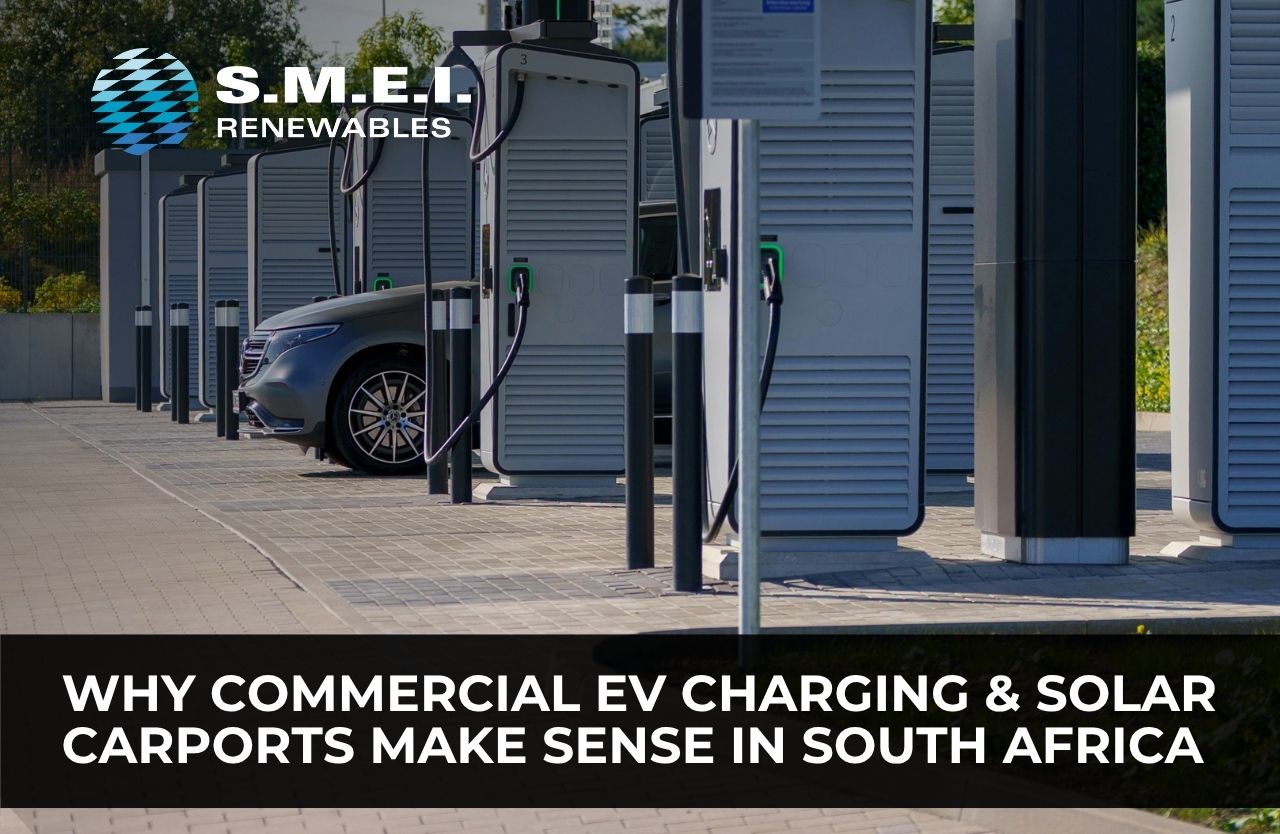
Electric vehicles charging beneath a solar canopy on a commercial parking lot

Why Commercial EV Charging + Solar Carports Make Sense in South Africa

  1. Growing EV adoption + grid volatility

Electric vehicle use in South Africa is still nascent, but growing. The local charging-station network is expanding, and commercial sites need to stay ahead of the curve.

At the same time, load-shedding and high grid tariffs are imposing real cost pressures on commercial operations. Deploying onsite solar generation mitigates this exposure and serves as a strategic hedge.


  1. Optimised use of existing assets

Rather than adding new land or roof structures, car parks offer ideal real estate for solar canopy installations. These turn otherwise passive assets into productive ones. As an example, solar carports can serve dual functions: vehicle shelter + energy generation + EV charging station.


  1. EV charging infrastructure is future-proofing your site

Installing charging stations today positions your facility for the arrival of EV fleets, whether your own trucks, staff vehicles or customer cars. Pairing that with solar means you’ll have renewable supply backing the charging demand. According to industry commentary: “A solar carport canopy is the ideal infrastructure to support electric vehicle (EV) charging… helping future-proof your facilities.” Bluetopsolar


  1. Branding, ESG and revenues

Solar carports signal a visible commitment to sustainability. They may also provide revenue-generating opportunities through visitor EV charging, property differentiation, or even helping tenants/clients align with their ESG goals.


Key Components & Installation Considerations

When you embark on a solar carport + EV charging project, the following areas are critical, and it’s here that S.M.E.I. Renewables’ end-to-end capability makes a difference.


Site selection & feasibility

  • Evaluate the parking area: orientation, shading, traffic flow, structural loading for canopy.
  • Assess solar irradiation, expected yield and estimated energy production from the carport array.
  • Review grid-connection or onsite distribution network capacity, how will the carport tie into your commercial site’s power system?
  • Analyse EV-fleet demand: estimated charging kWh per day/week, time-of-day use, number of chargers required, AC vs DC, vehicle types.


Structural & civil engineering

  • The carport structure must accommodate high-quality modules, weather loads (wind/snow if applicable) and vehicle clearances.
  • Foundations, drainage, surface treatment and site access must be designed for minimal business interruption.
  • At S.M.E.I., our construction teams are experienced in the civil/structural steel aspects of solar carports, ensuring a robust build scheduled around your business operations.


Electrical, mechanical & integration (EC&I)

  • Solar PV array (modules, inverters or optimisers, DC wiring) mounted on the carport roof.
  • EV charging stations installed beneath the canopy, connected to the PV system and/or the main site grid.
  • Power-electronic controls, metering and load-management systems: ensures that solar generation, EV loads and site demand are coordinated for reliability and efficiency.
  • AC-tie-in: The carport system must integrate with your site’s AC distribution, managing harmonics, protection, loads, and grid or micro-grid interactions. S.M.E.I.’s expertise in AC tie-in ensures the solution is engineered to commercial-scale standards.
  • Safety & codes: As commercial installations, the system must comply with South African electrical/regulatory standards and often needs to consider future EV-fleet expansions.
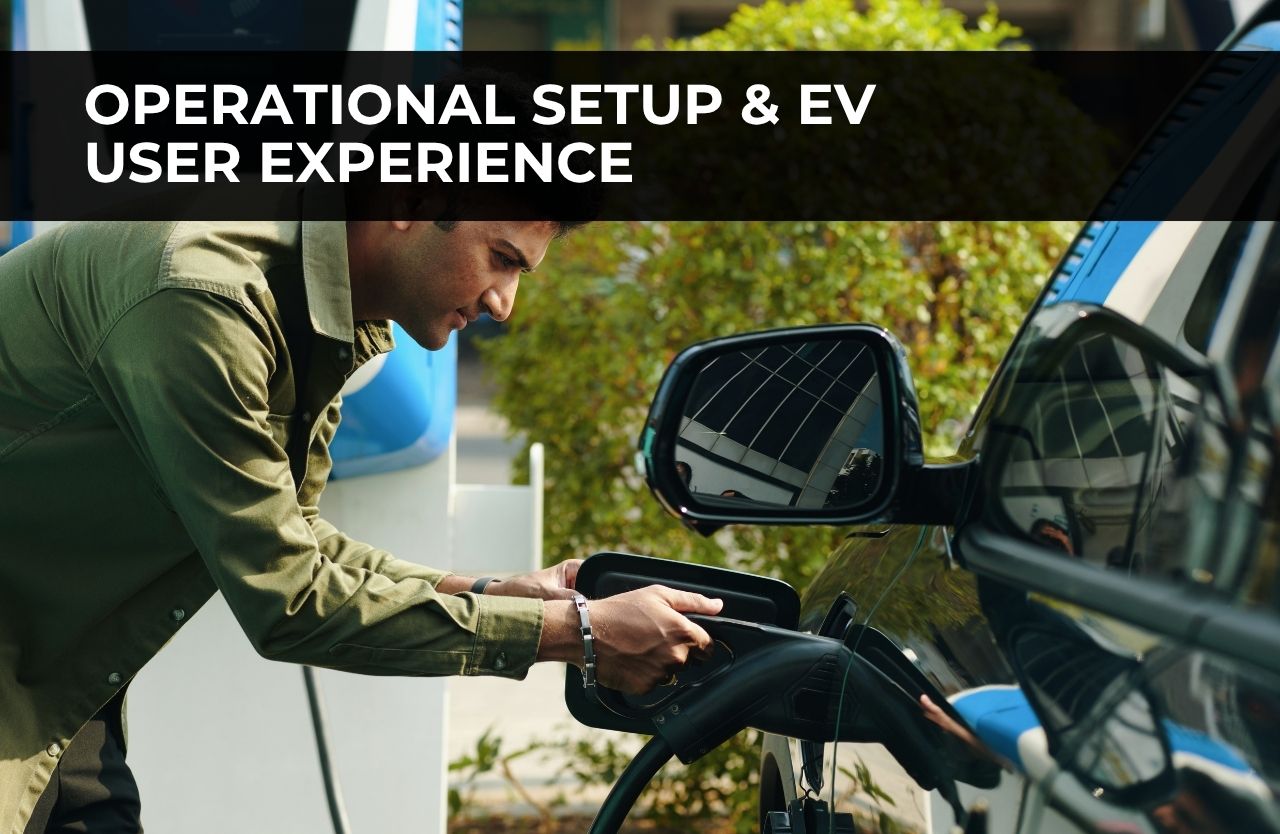
User experience with electric vehicle charging stations

Operational setup & EV user experience

  • Charging infrastructure should support commercial-grade EV fleets or mixed visitor/tenant use.
  • Monitoring systems (for PV output, energy consumption, charger usage) provide data for performance, billing, maintenance.
  • The shading of vehicles beneath the canopy improves user comfort and protects fleets: studies show carports also bring ancillary benefits beyond energy. VPS+1
  • Business model: Consider onsite consumption, PPA (Power Purchase Agreement) for solar generation, fleet charging tariffs, or revenue from visitor charging.


South African Market Snapshot & Local Relevance

  • A well-known South African example: BMW South Africa launched its first solar carport in 2016, supplying an average of 3.6 kW of solar power directly to an EV wall box.
  • Local installers already market commercial carport systems that integrate EV chargers, showing the model is viable in the South African context.
  • The benefits of carport-based solar generation for parking lots have been documented, notably the ability to turn parking areas into revenue-generating green assets.


How S.M.E.I. Renewables Delivers Value

  • End-to-end capability: From feasibility, civil & structural engineering, to PV mounting, EV charger installation, power-electronics and AC tie-in, S.M.E.I. covers the full chain. This reduces interface risk and makes your project timeline cleaner.
  • Commercial-grade installations: We handle large-scale structures, robust canopies, complex flows (fleet charging, mixed-use tenants), and enforce high standards.
  • Future-proof design: We design carport systems with flexibility for expansion (additional EV chargers, battery integration, vehicle-to-grid systems) so your site remains relevant as your EV fleet grows.
  • Local expertise & regional reach: Operating in South Africa and across the SADC region, we understand local procurement, regulations and supply-chain constraints.
  • Quality assurance & performance: We apply engineering and construction standards that ensure durability of the structure, reliability of charging, and return on investment over the life of the asset.


Practical Steps to Get Started

  1. Conduct a parking-audit: how many spaces are available, vehicle type, usage patterns, solar exposure, shutter-load profiles.
  2. Define your EV-fleet roadmap: number and type of EVs, charging requirements, expected growth.
  3. Request a solar carport feasibility study: yield modelling, canopy layout, EV charging infrastructure sizing, tie-in impact to your site power network.
  4. Agree on a technical scope & timeline: structure fabrication, PV installation, charger installation, AC tie-in, commissioning and hand-over.
  5. Review business model options: self-consumption, PPA, charging revenue model, integration with existing energy management systems.
  6. Select a partner with full EC&I capability and proven delivery track-record, that’s where S.M.E.I. Renewables fits.


Conclusion

For property owners and fleet managers in South Africa, the convergence of solar generation and EV infrastructure presents a compelling opportunity. Solar carports don’t just shelter vehicles, they transform parking areas into productive, resilient, future-ready energy hubs. They help control electricity costs, provide onsite charging for electric fleets, enhance ESG credentials and unlock new revenue streams.

By partnering with S.M.E.I. Renewables, you gain access to a robust, end-to-end solution – bridging structure, PV, charging technology and grid integration – so you’re not just ready for today’s EV trend, but positioned for tomorrow’s mobility-driven world.

Contact S.M.E.I. Renewables today to explore how your parking area can become a solar-charged EV asset.

Driving Toward the Future: The Benefits of Solar-Powered EV Charging Stations for South African Businesses

Driving Toward the Future: The Benefits of Solar-Powered EV Charging Stations for South African Businesses

As the world shifts towards greener energy solutions, the rise of electric vehicles (EVs) is transforming how businesses think about mobility and sustainability. In South Africa, this trend is gaining momentum as companies increasingly seek ways to reduce their carbon footprint and position themselves at the forefront of innovation. One of the most effective ways to support this green transition is by installing solar-powered EV charging stations.

Solar EV charging stations are the perfect blend of renewable energy and green mobility. By harnessing solar power to charge EVs, businesses can not only provide charging infrastructure for employees and customers but also cut costs and reduce their reliance on the national grid. In this blog, we explore the benefits of installing solar-powered EV charging stations, the cost savings they offer, and real-world examples of businesses leading the way in South Africa.

Solar-Powered EV Charging: A Game-Changer for Green Mobility

Solar-Powered EV Charging: A Game-Changer for Green Mobility

As electric vehicles become more prevalent in South Africa, the demand for convenient and accessible charging infrastructure is growing. Businesses are recognising the value of solar-powered EV charging stations as a way to enhance their sustainability efforts while offering a practical service to employees, clients, and even the general public.

Solar-powered EV charging stations use solar panels to generate electricity, which is then stored and used to charge electric vehicles. By using renewable energy instead of grid electricity, these stations help businesses significantly reduce their energy costs while contributing to South Africa’s green mobility revolution.

According to the International Energy Agency (IEA), global EV sales surpassed 10 million in 2022, and South Africa is steadily catching up. While the local EV market is still growing, the momentum is clear. The South African government has committed to developing policies and incentives to promote electric vehicle adoption as part of its strategy to reduce greenhouse gas emissions.

The Financial Benefits of Electrice Vehicle Charging Stations: Cutting Costs with Solar-Powered EV Charging Stations

The Financial Benefits: Cutting Costs with Solar-Powered EV Charging Stations

The cost-saving potential of solar-powered EV charging stations is one of their most compelling benefits. South Africa’s electricity prices have been on a steady rise, with Eskom’s tariffs increasing by 18.65% in 2023, and further increases expected. Relying on grid electricity to charge a fleet of electric vehicles or offer EV charging services could result in prohibitively high operating costs for businesses.

By using solar energy to power EV chargers, businesses can drastically reduce these costs. Solar-powered EV charging stations provide businesses with a free, renewable energy source that reduces reliance on the grid, stabilises energy expenses, and offers long-term savings.

Additionally, South Africa’s high levels of sunlight make solar energy a particularly viable option. With an average of 2,500 hours of sunshine annually, solar EV charging stations can operate at maximum efficiency, making them a smart investment for businesses looking to reduce both energy costs and their environmental impact.

Real-World Examples: South African Businesses Leading the Way

Several businesses and organisations across South Africa are already embracing solar-powered EV charging stations as part of their green energy strategy. These pioneers are demonstrating that solar-powered EV infrastructure is not just a futuristic idea—it’s happening now.


Growthpoint Properties

Growthpoint, one of South Africa’s largest property companies, is leading the charge by installing solar-powered EV charging stations at several of its office parks. The company has integrated solar panels into its parking facilities to provide a clean energy source for EV chargers, allowing tenants and visitors to charge their vehicles while reducing their carbon footprint. Growthpoint’s initiative aligns with its broader goal of reducing emissions across its property portfolio and promoting sustainability among its clients.

Absa Bank

Absa has been integrating EV charging stations at its head office in Johannesburg, powered by a large-scale rooftop solar installation. This move is part of Absa’s commitment to reducing its carbon footprint and promoting clean energy usage. The solar-powered charging stations serve both employees and visitors, reinforcing the bank’s leadership in green energy adoption.

Eskom’s Solar-Powered EV Charging Stations

Eskom has been taking steps toward sustainability by installing solar-powered EV charging stations as part of its green energy initiatives. These stations are designed to support Eskom’s goal of reducing its carbon footprint and promoting the use of renewable energy. By integrating solar PV systems with their EV charging infrastructure, Eskom is setting an example for other businesses in South Africa, showcasing how solar energy can be effectively harnessed to power electric vehicles.

These charging stations not only provide a renewable source of energy for electric vehicles but also help Eskom demonstrate its commitment to clean energy and reducing reliance on fossil fuels. This initiative supports South Africa’s shift towards cleaner energy solutions and encourages wider adoption of EVs across the country.

These examples highlight the growing trend of businesses and organisations across South Africa that are investing in solar-powered EV infrastructure, paving the way for a greener, more sustainable future.

Enhancing Business Appeal: The Sustainability Advantage of Electric Vehicle Charging Stations

Enhancing Business Appeal: The Sustainability Advantage

Beyond cost savings, installing solar-powered EV charging stations gives businesses a distinct competitive edge in the market. Offering solar EV charging on your premises demonstrates a strong commitment to sustainability, which can be a key differentiator for both customers and employees.

Consumers are increasingly prioritising environmentally responsible businesses, and the availability of EV charging stations powered by clean energy can enhance a company’s brand perception. In a 2021 Deloitte Global Automotive Consumer Study, more than 50% of South African respondents indicated that environmental impact is a critical factor in their vehicle purchase decisions. By offering solar-powered EV charging, businesses can attract eco-conscious customers and align with broader sustainability trends.

Moreover, providing EV charging stations is a way to future-proof your business as the adoption of electric vehicles in South Africa continues to grow. Early adopters of this technology will be well-positioned to capitalise on the growing demand for EV infrastructure.

S.M.E.I. Renewables: Your Partner in Solar EV Charging Solutions

S.M.E.I. Renewables is at the forefront of South Africa’s renewable energy movement, providing innovative solar solutions for commercial spaces. As businesses look to integrate green mobility into their operations, S.M.E.I. Renewables is here to help with tailored solar-powered EV charging solutions. Our team can assess your property’s solar potential, design a customised EV charging solution, and ensure seamless integration with your existing energy systems.

By investing in solar-powered EV charging stations, you’re not just adopting a trend—you’re positioning your business for long-term sustainability and financial savings. Let S.M.E.I. Renewables help you lead the way in South Africa’s green mobility revolution.

Conclusion: Powering the Future of Green Mobility

As electric vehicles become more popular and South Africa pushes towards a cleaner energy future, businesses have a unique opportunity to lead the charge with solar-powered EV charging stations. From cost savings to enhanced sustainability, the benefits are clear. With solar energy, businesses can power their EV charging infrastructure in a way that’s both environmentally responsible and economically sound.

For more information on how solar-powered EV charging stations can benefit your business, contact S.M.E.I. Renewables today for a customised consultation.