
There is a version of the fixed tilt vs tracker solar systems debate that lives entirely in a spreadsheet. Tracker yield uplift: 20 to 35 percent. Tracker CAPEX premium: 10 to 20 percent. Lower LCOE over 25 years: confirmed in most high-irradiance markets. Decision made.
That version of the decision is not wrong. It is incomplete. The engineering variables that determine whether a tracker system actually performs as modelled, or whether fixed-tilt is the sounder choice for a specific project, do not appear in yield simulations. They appear in geotechnical reports, wind climate analyses, and occasionally in the post-construction investigations that follow structural failures on sites where those factors were not adequately addressed.
Our earlier overview of the fixed tilt vs tracker decision covers the yield fundamentals, cost comparison, and which SA provinces favour each system. This article goes a level deeper: the structural mechanics, specific failure modes, site-condition constraints, and O&M realities that the comparison tables cannot capture.
What Trackers Actually Introduce: Mechanical Complexity at Scale
A fixed-tilt structure is static and load-bearing. Its failure modes are well understood, governed by static calculations for wind uplift, dead load, and foundation resistance. The engineering is mature and the structure behaves the same way on day one as it does in year twenty.
A single-axis tracker is a fundamentally different category of structure: a long, rotating steel assembly driven by motors or actuators, connected along its length by a torque tube, and supported at intervals by driven piles. The drive mechanism requires lubrication and inspection. Bearings at each pile location accumulate millions of load cycles over the system’s design life. The control system managing row position, backtracking algorithms, and stow commands requires firmware maintenance and sensor calibration. Each of these is a wear cycle that a fixed-tilt rack does not carry. Together they accumulate across the Operations and Maintenance (O&M) programme over 25 years in ways that a Day 1 yield model does not capture.
Torsional Galloping: The Structural Risk That Rarely Appears in Project Proposals
Of all the structural risks specific to single-axis trackers, torsional galloping is the one that has caused the most field failures and generated the most engineering research. It is also the risk least visible in the project development phase.
Torsional galloping is an aeroelastic instability. When wind flows across a tracker panel stowed at or near zero degrees from horizontal, it generates vortices at the leading edge that produce a twisting torque on the torque tube. If wind speed is sufficient and structural damping is inadequate, the row begins to oscillate rotationally with increasing amplitude, eventually reaching failure. A peer-reviewed structural investigation published in Renewable and Sustainable Energy Reviews confirmed this as the cause of a real-world tracker collapse, the failure occurring at the stow position specifically intended to protect the structure during high winds.
CPP Wind Engineering’s foundational research on tracker torsional instability established that the instability can occur at wind speeds below the tracker’s design load, is not mitigated by moderate structural damping, and is best addressed through stow angle strategy rather than additional structural mass. Stowing at an elevated angle forces vortices to shed on one side of the panel only, stabilising the row. A 2025 extreme weather risk assessment documented adjacent solar farms in Queensland, Australia, that experienced dramatically different outcomes during the same severe storm. The critical variable was not hardware specification. It was the engineering of the stow response.
For developers and EPCs in South Africa, this is not abstract. SANS 10160-3:2019 already reflects research showing that South Africa’s wind climate is more severe than European standards assume, with convective gust fronts across the interior and extratropical cyclone events along the southern and western coasts. Tracker engineering in these zones requires site-specific wind analysis and a validated stow strategy, not code compliance alone.
Where the Tracker Advantage Erodes: Three Site Variables
Terrain slope is the first constraint that developers underestimate. Standard single-axis tracker torque tubes must be installed in a single horizontal plane, requiring earthworks on sites with meaningful topographic variation. PV-Tech’s 2024 analysis of terrain-following systems confirms that slope gradients on conventional tracker sites rarely exceed 10 percent, and that even terrain-following designs require careful pile height analysis to avoid structural hazards along the row. Fixed-tilt accommodates slope through post height adjustment without the same row-alignment requirements.
Soil conditions carry equal weight. Polar Racking’s comparative analysis confirms that driven pile foundations, the standard for commercial tracker systems, become difficult and expensive in loose sand, near-surface rock, or variable subsurface conditions. Fixed-tilt offers a wider foundation toolkit, including helical piles and cast-in-place solutions, giving it a practical structural advantage on the variable ground profiles documented in geotechnical surveys of solar PV sites across South Africa’s Northern Cape.
Wind frequency at stow-triggering speeds is the variable most consistently absent from financial models, and the one with the most direct impact on whether the tracker premium is ever actually realised. Solar Power World’s 2025 industry analysis quotes a director of engineering making the point plainly: in high-wind regions where trackers spend significant hours in stow position, they are effectively operating as fixed-tilt systems. The yield premium they were selected for does not materialise during those periods. The CAPEX and O&M premium they carry does not disappear.
The O&M Gap That Compounds Over 25 Years
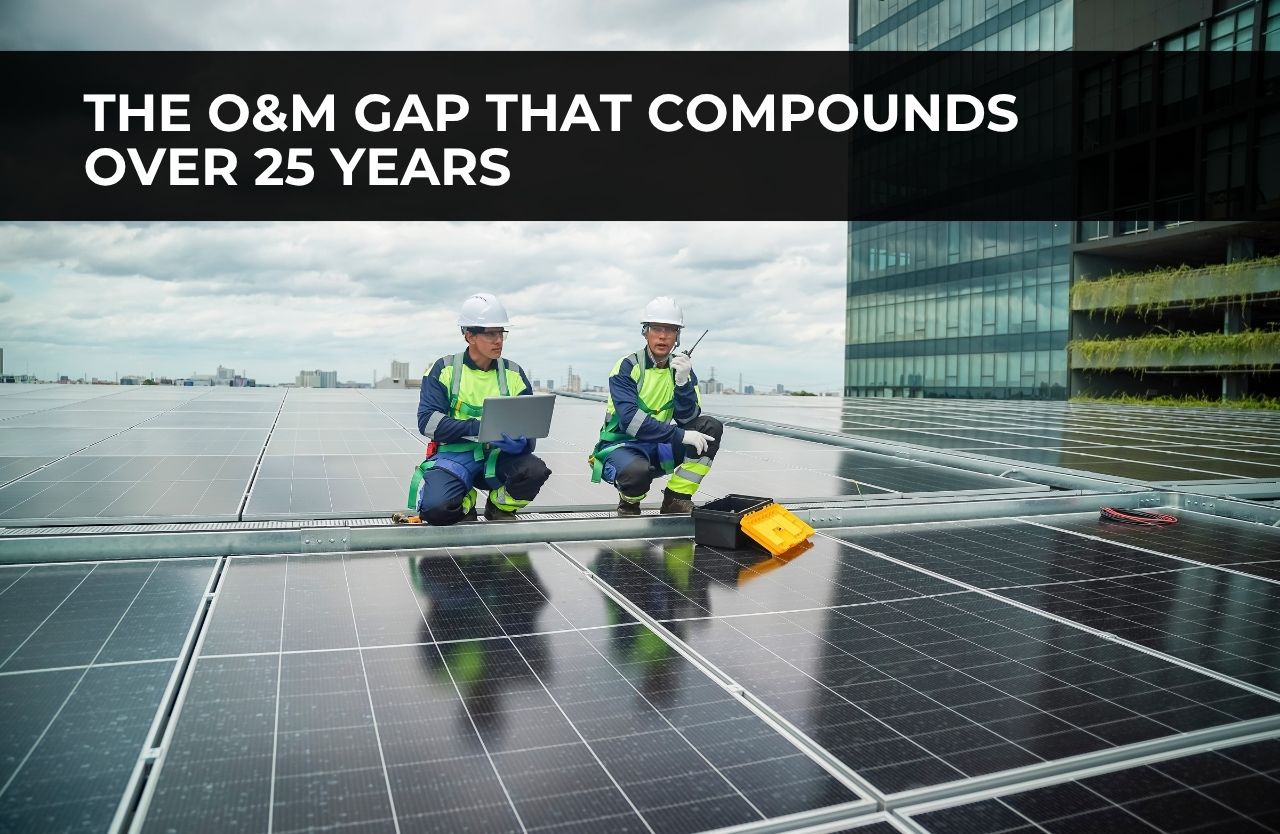
The O&M difference between these two system types is not a rounding error. Fixed-tilt maintenance is predictable and low-intensity: module cleaning, connection checks, vegetation management, and periodic structural inspection. There is no drive system to service and no actuation hardware approaching end of replacement cycle.
PVRack’s utility-scale reference data places tracker O&M costs at 15 to 30 percent above equivalent fixed-tilt systems, reflecting motor servicing, bearing inspection, control system calibration, and the corrective maintenance demands of drive faults. The South Africa Solar O&M Best Practice Guidelines require monitoring systems to capture data from all mechanical and electrical components at 15-minute intervals, with structured corrective maintenance protocols for drive system events. These are competencies requiring trained personnel and an accessible spare parts inventory within a defined response radius.
For mining operations and remote infrastructure projects across southern Africa, where specialist tracker components can carry lead times measured in weeks and the nearest qualified drive system technician may be several hundred kilometres from site, this is a project variable that belongs in the pre-FID analysis, not the post-commissioning review.
When Fixed Tilt Is the Right Engineering Answer
In specific site conditions, fixed-tilt is not the compromise. It is the better-engineered choice.
High-wind exposure makes the argument most clearly. Where SANS 10160-3 wind loads sit at the upper end of the national spectrum, the engineering path for fixed-tilt is a deterministic exercise in static loads, steel sections, and foundation design. The engineering path for a tracker on the same site adds torsional instability analysis, stow strategy validation, aeroelastic damping assessment, and control system wind response testing. Both can be executed well. One carries substantially more complexity and design risk than the other.
Geography matters too. Research covering more than 80 African weather station records, published in a peer-reviewed study of solar orientation and tracking across West and Central Africa, found that in sandy, windy Sahel environments and high-diffuse equatorial regions, solar tracking delivers no meaningful yield advantage over optimised fixed-tilt. In parts of Africa where dust loading, cloud cover, or diffuse irradiance suppresses direct normal irradiance, the tracker premium simply does not materialise.
Sites with geotechnically complex ground unsuited to driven pile foundations, remote locations with constrained O&M access, and projects where the tracker CAPEX premium cannot be recovered within the financing structure are all cases where fixed-tilt delivers lower risk, more predictable performance, and a cleaner path to long-term returns.
Execution Determines Whether the Right Decision Becomes the Right Outcome
The right choice between fixed tilt and tracker solar systems is site-specific. It is determined by DNI, terrain, soil, wind climate, O&M access, and financing constraints, not by a generic preference for one technology over another.
S.M.E.I. Renewables constructs both systems to the same ISO 9001, ISO 45001, and ISO 3834 certified quality standards. We do not advocate for either technology. What we bring is construction-phase experience with both: the tracker foundation pile that meets rock at 0.3 metres on an under-surveyed site, the stow event on a site in a wind acceleration corridor between two ridges, the drive system fault call when the nearest qualified technician is 300 kilometres away. These are the realities a yield model cannot anticipate, and they are the realities that determine whether a project delivers on its financial model over 25 years.
If your project is at the pre-engineering stage of the fixed tilt vs tracker solar systems decision, contact S.M.E.I. Renewables to discuss a site-specific structural and O&M assessment before the design is locked.
Sources and References
[1] Solar Tracker — Global Market and Technology Overview. Wikipedia. https://en.wikipedia.org/wiki/Solar_tracker
[2] Why southern Africa’s interior is an ideal place to generate solar energy. The Conversation (2024). https://theconversation.com/why-southern-africas-interior-is-an-ideal-place-to-generate-solar-energy-161030
[3] Failure investigation of a solar tracker due to wind-induced torsional galloping. Renewable and Sustainable Energy Reviews, ScienceDirect (2022). https://www.sciencedirect.com/science/article/pii/S135063072200111X
[4] Rohr, Bourke, Banks (2015). Torsional Instability of Single-Axis Solar Tracking Systems. CPP Wind Engineering. https://cppwind.com/wp-content/uploads/2014/01/Torsional-Instability-of-Single-Axis-Solar-Tracking-Systems-Rohr-Bourke-Banks-2015.pdf
[5] Mitigating Extreme Weather Risk in Solar Tracker Systems. RELX/SDG Resources (2025). https://sdgresources.relx.com/reports/mitigating-extreme-weather-risk-solar-power-plants
[6] Viljoen, C. et al. (2022). Incorporation of additional information into the South African Wind Load Formulation. SAICE Journal of Civil Engineering. https://scielo.org.za/scielo.php?script=sci_arttext&pid=S1021-20192022000100003
[7] How terrain-following trackers are helping boost PV project viability. PV-Tech (2024). https://www.pv-tech.org/terrain-following-trackers-helping-boost-pv-project-viability/
[8] Pros and Cons of Ground-Mount Fixed-Tilt Solar Racking and Single-Axis Trackers. Polar Racking. https://www.polarracking.com/pros-and-cons-of-ground-mount-fixed-tilt-solar-racking-and-single-axis-trackers/
[9] Geotechnical Evaluation for Proposed Solar PV Facility, Kakamas, Northern Cape. FAO AGRIS Research Database. https://agris.fao.org/search/en/providers/124746/records/671271767f591113e2a693c6
[10] Fixed-tilt racking still has a place in utility-scale solar. Solar Power World (2025). https://www.solarpowerworldonline.com/2025/04/fixed-tilt-racking-still-has-a-place-in-utility-scale-solar/
[11] Fixed-Tilt Solar PV Mounting Systems: Engineering Parameters and Cost Reference. PVRack. https://pvrack.com/types/fixed-tilt/
[12] Best Practices for Solar O&M in South Africa. REGlobal / GreenPower Monitor. https://reglobal.org/best-practices-for-solar-om-in-south-africa/
[13] Effect of orientation and tilt angles of solar collectors on their performance: West and Central African context. ScienceDirect (2021). https://www.sciencedirect.com/science/article/pii/S2468227621003707
[14] Tracker Systems vs Fixed Tilt: What’s Best for Large-Scale Solar Projects? S.M.E.I. Renewables. https://www.smeirenewables.co.za/tracker-systems-vs-fixed-tilt/