
Mining operations do not give infrastructure an easy ride. The dust is abrasive. The vehicles are large. The shift patterns are punishing. Power demand is high, often concentrated in daylight hours, and the consequence of an unplanned outage can ripple through an entire production cycle.
Against that backdrop, solar carports might not seem like the obvious starting point for a renewables conversation. They are more commonly associated with retail parks and corporate campuses than haul roads and workshop yards. That perception understates what a well-engineered solar carport can actually do on a mining or heavy industrial site and it ignores the structural and electrical capabilities that make the difference between an installation that survives the environment and one that does not.
S.M.E.I. Renewables builds solar carports within a parent company whose 25+ year track record is in structural, mechanical, and electrical construction on exactly these kinds of sites. This article is a practical look at where solar carports fit in mining and heavy industry, what the engineering requirements actually are in those environments, and what decision-makers should be asking before the design begins.
Where Solar Carports Fit on Mining and Industrial Sites
The most common objection to solar carports in heavy industrial settings is spatial: mining operations are space-constrained around their operational core, and the assumption is that there is nowhere to put a covered PV structure without displacing something more important.
In practice, the opposite is often true. Mining operations generate substantial covered parking demand across multiple categories light vehicles for personnel, service vehicles for maintenance crews, equipment bays for smaller mobile plant, and logistics staging areas. These are spaces that already exist, that already require some form of weather or sun protection in South Africa’s climate, and that sit under open sky for the majority of their useful life. A solar carport does not compete with those functions. It adds a productive layer above them.
The energy alignment is unusually strong. Mining operations typically run their highest electrical loads during daylight hours processing equipment, ventilation, pumping, and materials handling are all daytime functions. Solar generation peaks at exactly the same time. This is the set of conditions where solar generation can reduce Scope 2 emissions where it displaces purchased grid electricity, and may also reduce Scope 1 emissions where it reduces reliance on on-site diesel generation.
For operations that already run diesel generation or hybrid power systems, this alignment has a direct financial consequence. Every kilowatt-hour generated by a rooftop or carport solar system during peak production hours is a kilowatt-hour that does not have to be generated at diesel cost. At typical commercial diesel rates in South Africa and at the distances from the grid that characterise many mining operations the cost differential is significant.
Structural Engineering in Industrial Environments: What Changes
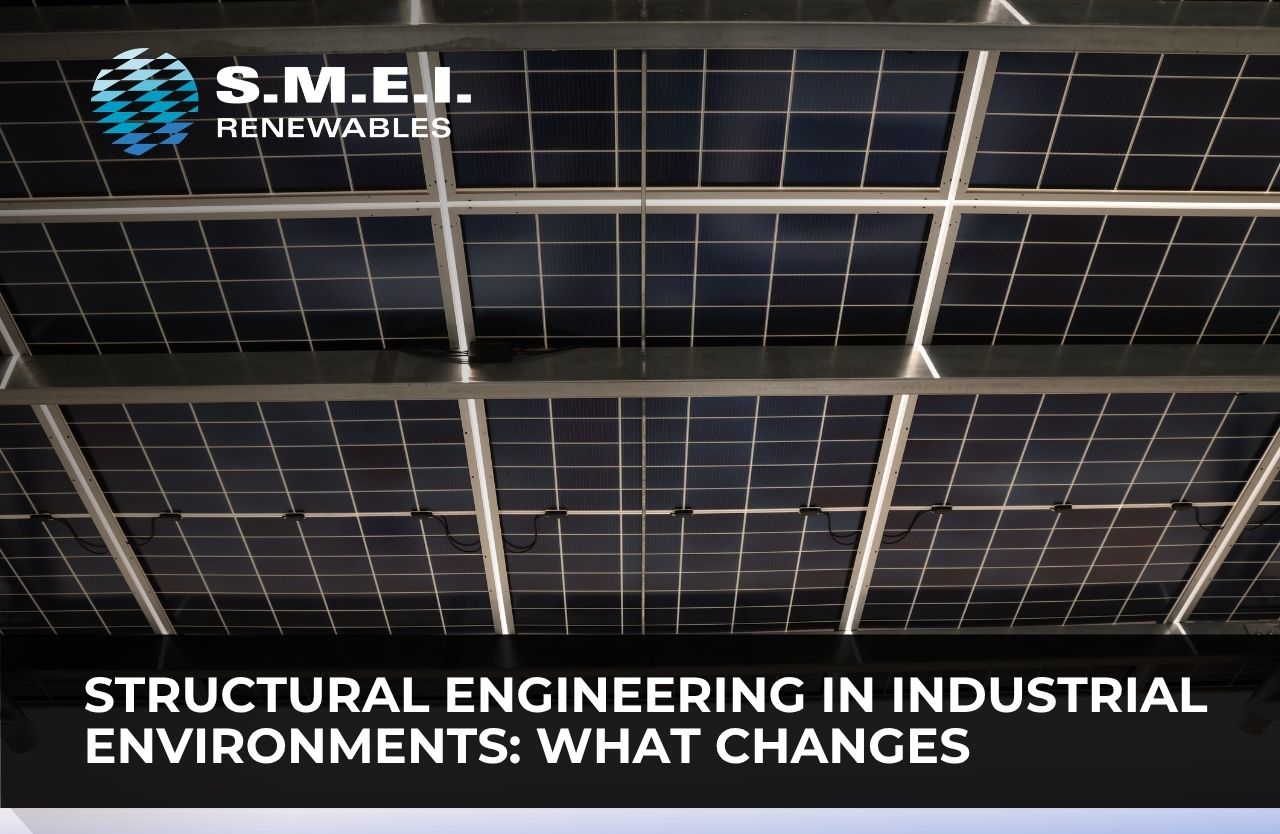
A solar carport designed for a corporate headquarters car park and a solar carport designed for a mining workshop yard are not the same structure. The engineering inputs are different, the design loads are more demanding, and the durability requirements carry higher stakes.
Wind and dust loading. Mining sites in South Africa’s Northern Cape, North West, and Limpopo provinces sit in regions with both high dust burden and significant wind exposure. Dust accumulation affects module performance, a well-documented relationship in semi-arid and arid environments, but it also adds dead load to the structure in a way that standard carport design tables do not account for. Wind loading must comply with SANS 10160-3:2019, and in regions where convective gust fronts are a regular seasonal feature, site-specific wind analysis is the appropriate starting point rather than generic zonal load tables.
Clearance requirements. Standard commercial carport clearance calculations are based on the passenger vehicle design envelope. Mining and industrial sites operate a completely different vehicle fleet. Light duty bakkies and service vehicles need a minimum clearance of approximately 2.8 to 3 metres. Larger maintenance vehicles, elevated flatbeds, and mobile workshop units routinely need 4.5 metres or more. Getting this wrong does not produce a minor inconvenience. It produces a structure that blocks operational access and must either be modified or removed. Clearance decisions must be made from actual vehicle survey data, not assumptions.
Corrosive and abrasive environments. Mineral extraction sites generate airborne particulates that are more chemically aggressive than typical atmospheric dust. Sulphide ore processing, for instance, generates sulphurous compounds that can accelerate zinc depletion in standard hot-dip galvanised coatings. This does not mean galvanised steel is the wrong material choice, it usually remains the correct one, but it does mean that coating specification must account for the site’s specific corrosion category rather than a generic ‘industrial’ classification. SANS 121 sets minimum coating thicknesses by base steel dimensions; the question of which coating category applies to a specific mining environment requires site-specific assessment.
Seismic and vibration considerations. Heavy plant, haul road proximity, and blasting activity on operating mines create vibration inputs that do not appear in standard carport design assumptions. Column bases, connection details, and foundation embedment depths on sites with regular ground vibration inputs require analysis that accounts for these loading cycles explicitly.
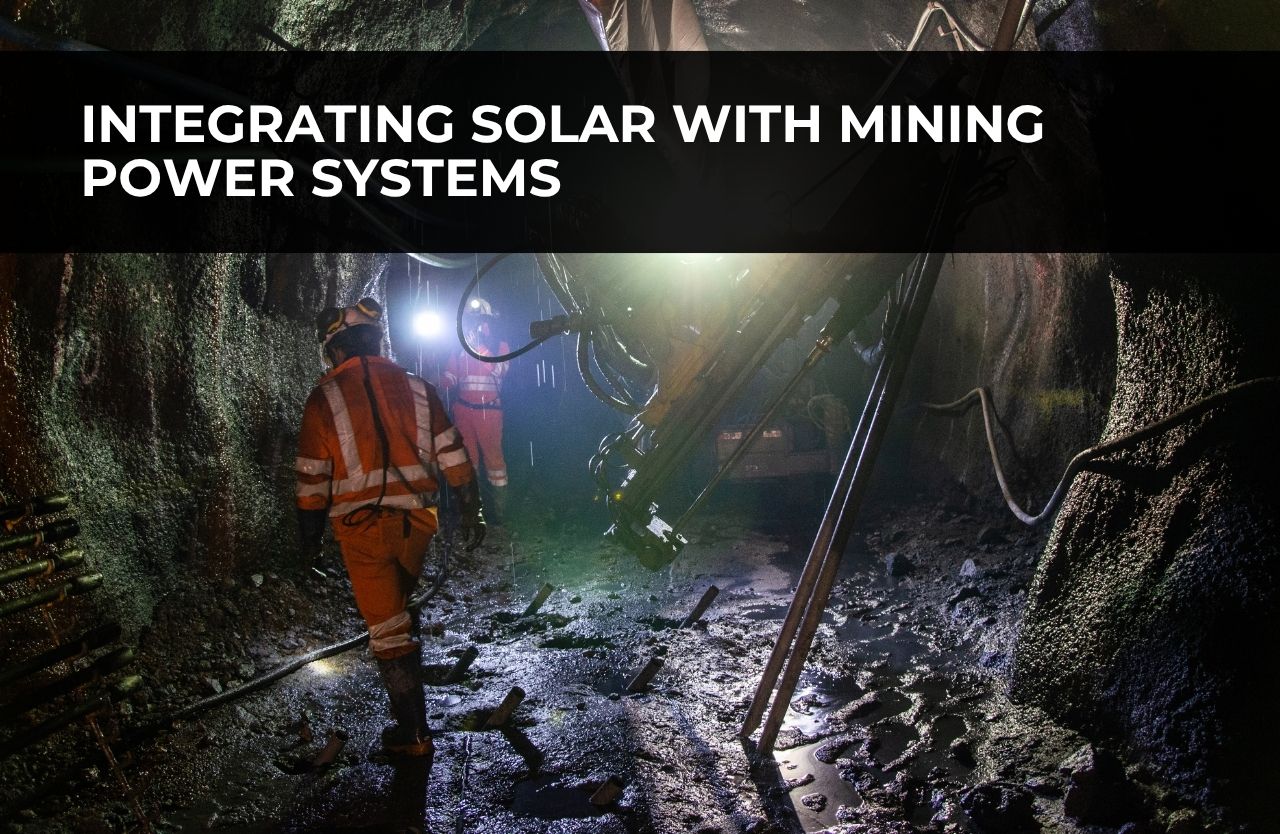
Integrating Solar with Mining Power Systems
A solar carport on a mining site is not a standalone power source. It is a generation asset that needs to be integrated into an existing power system, one that, for most South African mining operations, includes a combination of Eskom grid supply, diesel generation, and increasingly, battery storage.
The integration design determines whether the solar carport delivers its expected financial return. Key decisions include:
- Where the inverters connect into the existing LV or MV distribution board, and whether that connection point has available capacity.
- How the system handles grid outage conditions whether it is islanding-capable for critical load support, or whether it shuts down safely to avoid backfeed.
- Whether the generation profile is being actively monitored and dispatched against the site’s tariff structure, or simply generating whenever the sun shines.
- Whether battery storage integration is required to shift morning and evening peaks, or whether the daytime demand alignment makes storage unnecessary for the initial phase.
For mining operations with embedded network licences or private power purchase agreements, the metering and compliance requirements add another layer to the integration design. These are not insurmountable, but they need to be addressed during the engineering phase, not discovered during commissioning.
S.M.E.I. Renewables carries full EC&I (Electrical, Control and Instrumentation) capability inside its delivery model. That means the generation integration, the protection relay settings, the SCADA interface, microgrid control, and the monitoring system are all engineered and installed by the same team that designs and builds the structure. On a mining site, where system integration failures carry operational consequences, that matters.
Operational Advantages Beyond the Energy Bill
The financial case for solar carports on mining sites is usually led by energy cost reduction, and the numbers are generally compelling. But the business case is broader than the electricity tariff calculation.
ESG reporting and compliance: Mining companies operating under modern environmental and social governance frameworks face increasing scrutiny on Scope 1 and Scope 2 emissions. Solar generation that directly displaces diesel or coal-fired grid electricity reduces Scope 2 emissions in a way that is measurable, verifiable, and reportable. For companies subject to investor ESG requirements or government licensing conditions with renewable energy components, this is not a secondary consideration. It is a compliance obligation with financial consequences if not met.
Energy resilience: Eskom’s load shedding record over the past decade is well understood by every energy manager in South African mining. Solar carport generation does not eliminate grid dependency most systems without battery storage will still go offline during a grid outage, but hybrid configurations with battery backup can maintain critical loads through scheduled outages and reduce the operational impact on production-critical systems.
Covered infrastructure with dual function: A solar carport covers vehicles and equipment that would otherwise be exposed to hail, intense UV, and temperature extremes. On mining sites where vehicle fleets represent substantial capital assets, that protection has a measurable value that belongs in the business case alongside the energy yield calculation.
Personnel and contractor amenity:z Mining operations in remote locations depend on their ability to attract and retain skilled personnel. Covered, shaded parking and charging points for EVs or hybrid vehicles are amenity factors that have become increasingly relevant in recruitment and retention conversations, particularly for technical and engineering staff.
The Right Partner for the Right Environment
Solar carports in mining and heavy industry are not a simplified version of a retail installation. They are a more demanding version of it, with higher structural requirements, more complex power integration, more aggressive operating environments, and higher operational consequences if they underperform or fail.
Getting them right requires a team that understands both the solar system and the industrial environment it is going into. That combination is not common. It is what S.M.E.I. Renewables was built to provide.
If you are evaluating solar carport options for a mining or heavy industrial facility, contact S.M.E.I. Renewables to discuss a site-specific assessment. We operate under ISO 9001, ISO 45001, and ISO 3834 certified quality systems and carry full structural, renewable, and EC&I capability in-house.