
As energy costs rise, load shedding continues, and corporate sustainability becomes non-negotiable, solar carports are fast becoming a dual-purpose investment for retail, logistics, and commercial property managers in South Africa. Solar carports offer shade and protection for vehicles and generate electricity, pairs of benefits that deliver strong ROI. Below is an overview of what to know in 2025, with insights, numbers, and how S.M.E.I. Renewables can help.
What are Solar Carports & Why They’re Relevant Now
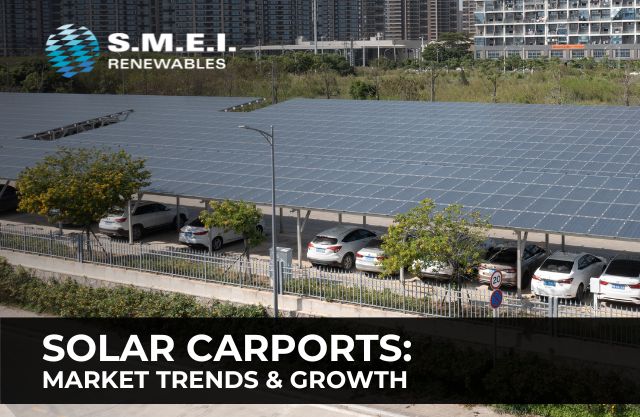
A solar carport is a carport with a roof that is made up of or supports photovoltaic (PV) panels. The structure supplies the dual function of protecting parked vehicles from the elements (sun, rain, etc.) while also generating electricity to offset grid consumption, reduce utility bills, and improve energy self-sufficiency.
With worsening grid reliability and rising electricity tariffs, businesses are looking for ways to stabilise energy costs, reduce exposure to load shedding, and meet sustainability targets. Solar carports allow property managers to use otherwise under-utilised parking space as a revenue-generating asset.
Market Trends & Growth
Here are a few recent trends relevant to solar carports in South Africa:
- The solar carport market in South Africa was worth about US$12.0 million in 2024, and is projected to reach US$28.8 million by 2033; that implies a compound annual growth rate (CAGR) of roughly 10.3% between 2025-2033.
- Types of carports gaining popularity include T-shape and semi-cantilever designs. T-shape was the largest revenue-generating type in 2024; semi-cantilever is the fastest growing segment.
- Local suppliers like S.M.E.I. Renewables offer mounting structures in galvanised or painted structural steel with flexible structural configurations to suit site constraints.
Costs, ROI & What Drives Value in South Africa
To evaluate whether a solar carport makes financial sense, you need to understand costs, savings, and local factors. Recent data shows many businesses can expect to recoup costs in 5-10 years, depending on electricity tariff, average sunlight, shading losses, and how much of their demand the carport offsets.
Other ROI enhancers include:
- Incorporating EV charging under the carport, which adds value and meets future mobility trends.
- Using high-efficiency panels, good mounting (minimise shading), and ensuring orientation to maximise yield.
- Leveraging property tax incentives, rebates, or savings from avoided energy purchases.
Key Considerations for Property & Logistics Managers
To maximise business performance from solar carports, attention to the following is essential:
- Orientation, shading, height & structural strength: Carports need enough height so vehicle access isn’t restricted; shading must be minimised for good solar output; structure must be engineered for local wind, snow/hail loads.
- Electrical integration: The balance between self-consumption vs feeding into grid; whether EV charging is included; permitting, metering, safety interlocks.
- Maintenance: Access to cleaning panels, replacing components, managing corrosion (especially in coastal or industrial atmospheres).
- Permits and regulation: Local building permits, electrical safety codes, possible zoning constraints. Potential incentives or tax breaks.
- Financial modelling: Include lifetime costs (panels, inverters, structure), expected energy output, tariff inflation, savings, depreciation. Also factor in potential for future demand growth (e.g. adding EV charging stations).
How S.M.E.I. Renewables Supplies & Installs Premium Solar Carports
Here’s how S.M.E.I. Renewables adds value to every solar carport project, making sure the dual purpose investment really delivers:
- Full end-to-end service: From site assessment, structural and electrical design, sourcing of high-quality panels & mounting systems, through to installation, commissioning, and ongoing maintenance.
- Custom design options: Ability to tailor design (material, form, size, EV integration) to match the aesthetic and operational needs of commercial, retail or logistics properties.
- Quality & standards: Use of Tier 1 PV modules, certified structural materials, compliance with local electrical and safety codes.
- Experienced project execution: Using local supply chains (e.g. for mounting structure, panels), ensuring strong timelines, safety & warranty.
- ROI focused modelling: Helping clients understand payback periods, savings, cash flow, tax / incentives, long-term value (property value, energy independence) from carport installations.
Challenges & How to Mitigate Them
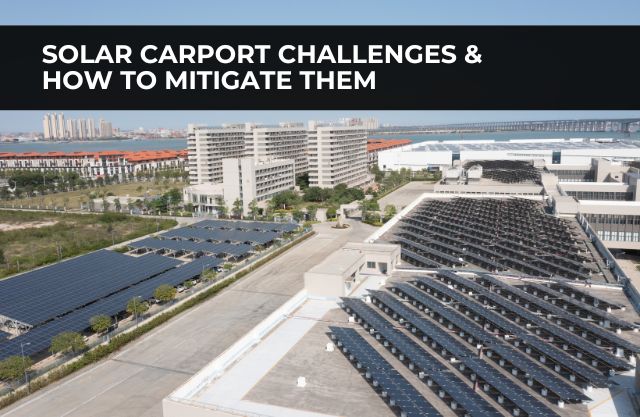
Even though solar carports are compelling, there are obstacles. Here are some of the more common ones, and how S.M.E.I. helps to address them:
- Capital upfront cost: Carport + panels + electrical + foundation + permits add up. Mitigation: phased installations, financing options, or PPAs, or cost sharing among tenants.
- Efficiency losses: Shading, suboptimal orientation, dust/soiling. Mitigation: good design, regular cleaning and maintenance, elevated roof designs, choosing durable materials.
- Permitting delays & local regs: Can slow projects. Mitigation: leveraging local expertise, early engagement with municipality, ensuring compliance to building / electrical codes.
- Structural & environmental constraints: Soil, height constraints, wind/hail risk. Mitigation: custom structural engineering; selecting materials suitable for environment; doing geotechnical and environmental impact assessments as needed.
Conclusion: Why Solar Carports Are Smart Business in 2025
Solar carports in South Africa are no longer a novelty. They are a practical, value-adding asset: generating power, increasing property appeal, improving sustainability credentials, and protecting vehicles. For retail centres, logistics depots, commercial properties with large parking lots, they offer one of the highest return per square metre of under-utilised space.
When done well, with the right design, quality materials, and efficient installation – solar carports can deliver solid ROI (often in 5-10 years), boost business performance, reduce exposure to tariff hikes and load shedding, and support sustainability.
If you’re considering solar carports and want them designed, built, and maintained to deliver both shade and serious energy value, S.M.E.I. Renewables is well positioned to help.
Contact us to explore a customised solar carport solution that aligns with your budget, site, and energy goals.