
Investing in renewable energy isn’t just a trend — it’s a business imperative. For South African companies weighing solar carports vs rooftop solar, ground-mounted farms, or energy-efficient upgrades, the decision can be complex. Solar carports are fast becoming a preferred choice for businesses with the right space, offering visibility, environmental impact, and dual-purpose use. But how do they stack up against other clean energy options?
In this article, we compare solar carports to alternative clean energy solutions and explore how visibility, scalability, and long-term ROI factor into a smart sustainability strategy.
Solar Carports vs. Other Clean Energy Investments
When strategising sustainability investments, companies often compare options like rooftop solar panels, ground-mounted solar farms, and energy-efficient building upgrades. Solar carports bring a unique mix of benefits to the table, but it’s useful to see how they stack up against other common clean energy approaches:
- Rooftop Solar vs. Solar Carports: Both rooftop and carport solar PV systems generate clean electricity on-site, but they differ in placement and visibility. Rooftop solar is typically constrained by the available roof area, roof orientation, and structural capacity of the building. If a facility’s roof is small, shaded, or cannot support the weight of panels, a carport offers an alternative by utilising open parking space. Rooftop installations usually have a lower cost per kW since the building structure is already in place; by contrast, carports incur extra costs for steel canopies and foundations. (One U.S. analysis noted that solar carports can be slightly more expensive due to the added structure.) However, carports provide additional value by shading vehicles and are highly visible to stakeholders. A solar array on a roof might go unnoticed, but a solar carport is immediately apparent to employees, customers, and passersby – effectively advertising the company’s green commitment. In terms of performance, both systems can be designed for optimal tilt and orientation to maximise generation; carports actually allow more freedom in panel orientation than roofs fixed to a building’s layout. Many companies opt to do both: install rooftop PV where it fits and add carports to further expand capacity once the roof is maxed out.
- Solar Farms (Ground-Mount) vs. Solar Carports: Large ground-mounted solar farms (either on-site if land is available, or off-site with power wheeled to the facility) can achieve economies of scale and often the lowest cost per kWh for solar. They are ideal for utility-scale generation or for organisations with significant open land. However, not every business has spare land adjacent to its operations – especially in urban or industrial areas where space is at a premium. Solar carports make use of an existing asset (parking lots), meaning no extra land is required. While ground mounts might slightly edge out carports in pure cost efficiency, carports double as infrastructure for the business (providing sheltered parking), thereby improving land-use efficiency. They also integrate more directly with the facility’s power usage (being right on-site, reducing transmission losses). In terms of scalability, a solar farm can be built as large as needed if land permits, whereas carports scale with the parking area. For many South African businesses, parking lots represent an untapped resource for solar – a mid-sized carport array can often generate a few hundred kilowatts to multiple megawatts, which significantly offsets a facility’s consumption without needing new real estate. Moreover, solar farms hidden in remote fields don’t garner public attention for the company, whereas a solar carport on your premises is a daily billboard of sustainability. Finally, solar carports can be integrated with EV charging stations more naturally in a parking context, something standalone solar farms can’t do on their own.
- Energy-Efficient Lighting vs. Solar Carports: Upgrading to LED lighting and high-efficiency equipment is a classic sustainability measure focused on reducing energy demand. Solar carports, on the other hand, focus on increasing clean energy supply. In practice, the best strategy is to do both – cut unnecessary energy use and then supply the rest with renewables. Energy-efficient lighting (like LEDs, smart controls, motion sensors) often has a quick payback and low upfront cost, making it a low-hanging fruit for CSR goals. However, its overall impact on a large facility’s carbon footprint may be modest – lighting might constitute only a fraction of total electricity usage. A solar carport involves a larger investment but can offset a much bigger chunk of grid consumption. In terms of cost and footprint, LEDs improve the internal environment (better light quality, lower heat load) without requiring additional space, whereas a carport is a noticeable physical addition. One advantage of efficiency projects is that they typically don’t require regulatory approvals or engineering of new structures, while solar carports do involve design and construction. That said, solar carports often attract more positive attention. An LED retrofit is invisible to outsiders, but a field of solar panels in your parking lot is a highly visible symbol of innovation. Both approaches are complementary: efficiency measures reduce the size (and cost) needed for a solar installation, and the solar carport then covers the optimised load with clean energy. Companies balancing their sustainability portfolio should invest in efficiency first (to eliminate waste) and then in generation like solar carports to cleanly power the remaining needs.
Solar carports compare very favourably with other green investments, particularly for companies with large parking areas and a desire for a high-profile sustainability project. They may carry a somewhat higher upfront cost than a simple rooftop array, but they deliver multi-faceted returns – energy, environmental, social, and practical (shade and comfort). By combining solar carports with other solutions (efficient appliances, rooftop panels, etc.), businesses can compound their gains and move rapidly toward both cost savings and carbon neutrality.
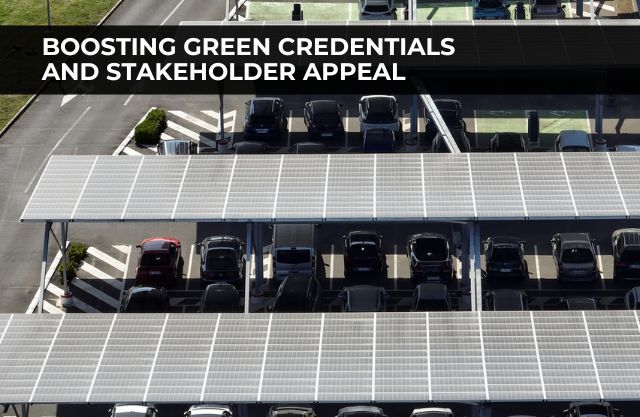
Boosting Green Credentials and Stakeholder Appeal
One of the often-underestimated benefits of solar carports is the boost they give to a company’s green credentials. Internally, they can inspire a culture of sustainability – employees take pride in parking under solar panels, knowing their workplace is powered by the sun. Externally, the visual impact of a solar carport is immediate. Clients visiting the premises see the solar installation and recognise the company’s commitment to clean energy at a glance. This kind of branding through infrastructure can enhance public perceptions significantly. A company that visibly invests in renewable energy distinguishes itself as an industry leader in sustainability, not just following compliance requirements but proactively innovating.
Environmentally conscious consumers are more loyal to brands that align with their values. As noted, a majority of South African consumers favour businesses with strong sustainability practices. Solar carports can become a selling point, included in marketing materials, annual reports, and media stories about the company’s green initiatives. They offer a concrete example of action: instead of simply buying renewable energy certificates or carbon offsets somewhere, the company has built something tangible that produces renewable energy on-site. This authenticity resonates with the public and can strengthen brand loyalty. It’s one thing to claim commitment to the environment; it’s another to demonstrate it with a visible solar installation.
In an era of increasing ESG integration in finance, companies with demonstrable sustainability projects may enjoy better access to capital and even lower costs of capital, as investors see reduced long-term risk. A solar carport, with its decades-long lifespan, signals that management is thinking ahead about energy costs and carbon regulations. It can improve the company’s risk profile by hedging against electricity price hikes and potential future carbon penalties. Additionally, if the company seeks sustainability-linked loans or enters an ESG index, projects like these serve as proof points of environmental performance improvements.
A solar carport project sends a message that goes far beyond electricity. It communicates that your business is aligned with global sustainability trends and national priorities to reduce carbon emissions. This can enhance relationships with government and regulatory bodies, too. Companies that proactively reduce strain on the grid and contribute to South Africa’s renewable energy capacity are often viewed more favourably during regulatory engagements (for example, when applying for licenses, permits, or incentives).
It’s a form of goodwill banking in the regulatory sphere by being part of the solution to the country’s energy and climate challenges.
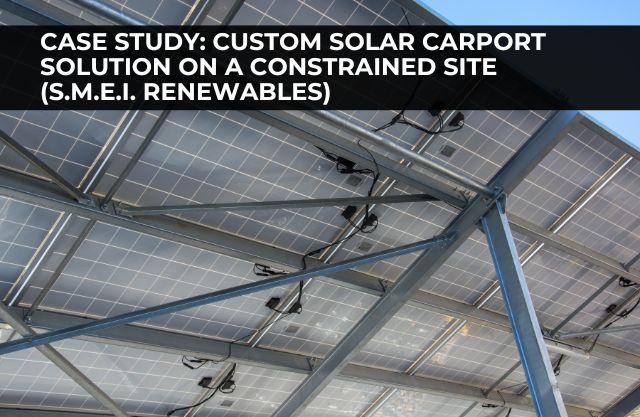
Case Study: Custom Solar Carport Solution on a Constrained Site (S.M.E.I.)
Sometimes, the decision to install a solar carport is straightforward – plenty of open parking space and a standard design will do. But in many cases, sites can be highly constrained, requiring advanced insight, planning, understanding, and engineering to make a solar carport viable. This is where S.M.E.I. Renewables’ expertise in structural and site-specific design truly shines.
As a real example, S.M.E.I. Renewables was approached by a client with a densely built site and minimal free space, where any solar installation had to be carefully integrated without disrupting operations.
The client – a diplomatic entity in Cape Town – had a parking lot that was oddly shaped and tightly hemmed in by embankments and access roads. The space for a solar carport was limited not only by the physical area but also by the need to maintain clear paths for vehicle movement (including larger vehicles) and adherence to zoning setbacks. Off-the-shelf modular solar carport systems proved inadequate for this scenario; their standard dimensions and column placements would have obstructed critical driveways and not fully utilised the irregular available space. Our engineering team conducted a thorough site analysis, taking into account every constraint: the turning radii of specific larger vehicles, height clearances for vehicles, existing curbs and landscaping, and the client’s own specific requirements.
Design Adaptations: With these inputs, we developed a custom solar carport design that would not have been possible with a generic kit. The design featured an asymmetrical layout to match the site’s geometry. By using a cantilevered structure with the column moved inward, the carport avoided placing columns along a busy access lane, preserving full vehicle access. The height of the carport was also tailored: one end was raised higher to accommodate the clients specific height requirements for access for specific vehicles, ensuring even large vehicles could comfortably pass underneath. This variable height and span required our structural experts to customise the steelwork and connections beyond standard templates. Additionally, the carport was designed with a slight tilt and orientation optimised for solar exposure at that specific location, which was something the modular options (usually pre-set angles) could not have matched precisely.
Despite the tight conditions, the final installation successfully covered the prescribed area, totalling roughly 60 kW of capacity. It now generates an estimated 100MWh per year of clean electricity for the client, a significant contribution given the facility’s limited footprint. During construction, we coordinated closely to phase the works and minimise disruption – another advantage of a custom approach, as the construction sequence was planned around the client’s daily operations (whereas a one-size-fits-all kit might have required shutting the entire parking area at once). The project was completed on time and within budget, thanks to meticulous planning and the flexibility that comes with in-house engineering capabilities.
This case highlights how our structural and site-specific engineering proficiency enables solar solutions in challenging environments. Spatial limitations that would normally rule out a solar carport were overcome through clever design adaptations. By not being bound to a catalogue of parts, S.M.E.I. could innovate a tailor-made solution, proving that even heavily constrained sites can enjoy the benefits of solar carports. The client not only met its sustainability target of adding on-site generation but did so without sacrificing valuable operational space or access. In the end, the custom carport became a showcase piece for the business – demonstrating both their commitment to green energy and the ingenuity of the engineering behind it. It stands as a model for other companies with less-than-ideal sites: with the right expertise, any site can be a green site.
Conclusion
A solar carport is more than a structure — it’s a strategic decision. Compared to other clean energy solutions, solar carports offer a rare blend of form, function, and future-readiness. While they may come with a slightly higher initial investment than rooftop systems or lighting upgrades, the visibility, dual-use design, and ability to generate clean energy in a space you already own make them uniquely valuable.
As we’ve seen from real projects, even the most constrained sites can unlock energy independence and sustainability credibility with the right engineering partner. For South African businesses looking to showcase impact, save on long-term costs, and align with ESG goals, the message is clear: look to your parking lot.
Ready to turn your parking lot into a clean energy asset?
Chat to the team at S.M.E.I. Renewables for a custom solar carport solution tailored to your site and sustainability goals.